

BLUF (Bottom Line Up Front)
If your Culpeper County home relies on a private well, you do not have a water utility standing behind you. Your water stops the moment your pump, pressure tank, pressure switch, or electrical supply fails to do its job. Most well failures are not random. They build for months through short cycling, longer pump runtimes, clogged filters from sediment, and rising electric bills that homeowners dismiss as usual. The most dangerous moments are peak summer demand and power restoration after outages, when worn motors and stressed controls finally give out. If you live near Brandy Station, Stevensburg, Richardsville, the Raccoon Ford Road corridor, or outside the Town of Culpeper, the right move is to treat pressure changes and electric bill increases as early failure warnings, not minor annoyances, because acting early is how you avoid a complete loss of water and a costly emergency replacement.
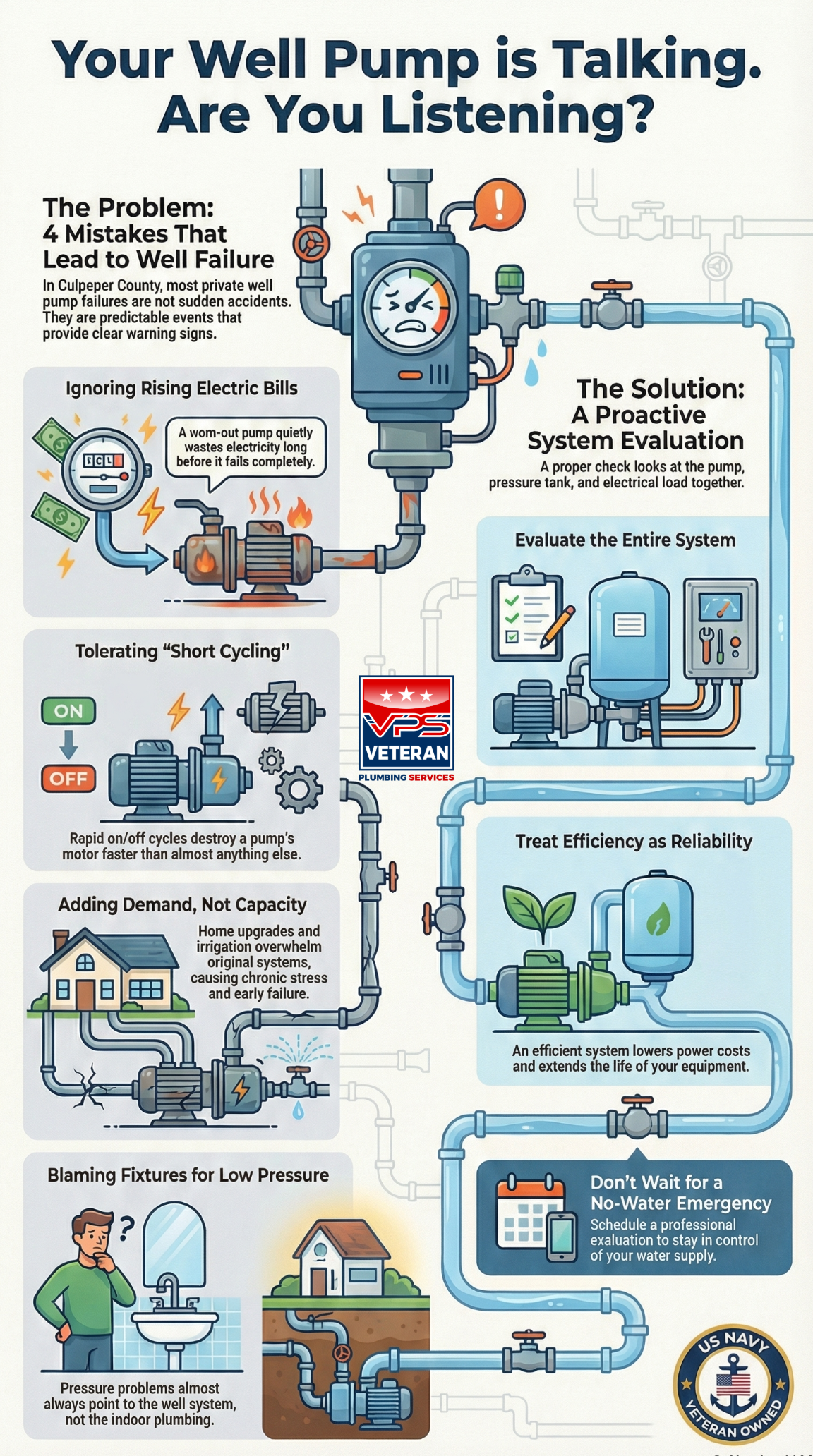
Table of Contents
- Reference: Towns and Communities Covered
- Chapter One: Northern and Northeastern Culpeper County
- Chapter Two: Central Culpeper County
- Chapter Three: Southern Culpeper County
- Chapter Four: Western Culpeper County
- Chapter Five: Agricultural Properties and Large Acreage Estates
- Chapter Six: Power Reliability and Outage Risk
- Chapter Seven: The Most Common Well Pump Mistakes
- Final Chapter: Protecting Your Well System Long Term
Towns and Communities Covered in This Guide
Here are the towns and named communities discussed in the Culpeper County Well Pump Guide:
Important Context
Only the Town of Culpeper has municipal water infrastructure. Every other area listed above relies primarily or entirely on private well pump systems, which is why they were included in this guide.
Chapter One
Northern and Northeastern Culpeper County
Brandy Station, the Raccoon Ford Road corridor, and surrounding rural areas
I am Dennis Rollins, owner of Veteran Plumbing Services, and Northern and Northeastern Culpeper County is one of the most deceptive well pump environments I work in. On the surface, these areas look manageable. Homes are spread out but not isolated. Roads are well traveled. Development feels steady and controlled. Under the ground, however, many of these well systems are operating much closer to failure than homeowners realize.
Homes in and around Brandy Station and along the Raccoon Ford Road corridor rely almost entirely on private wells. There is no municipal safety net. When the pump struggles, pressure problems appear fast. When the pump fails, water is gone completely.
Growth outpaced system design
Northern Culpeper has seen steady residential growth over the years. Many homes were built when water demand was simpler:
- One or two bathrooms
- Basic fixtures
- Minimal irrigation
- Smaller households
The well systems installed at the time reflected that reality. Today, those same homes often have finished basements, larger families, modern appliances, and outdoor water use. The house changed. The well system did not. This is one of the most common root causes of pressure loss and pump failure I see in this part of the county.
Sediment heavy groundwater wears systems quietly
Groundwater in this region often carries sediment. Even when water looks clear at the tap, fine particles move through the system every day. That sediment does real damage over time:
- It wears down pump impellers.
- It clogs filters faster than expected.
- It interferes with pressure switches and valves.
- It reduces overall flow efficiency.
As flow drops, the pump compensates by running longer. That extra runtime shows up as higher electric bills long before homeowners suspect a well issue.
Short cycling is widespread here
Short cycling is when the pump turns on and off rapidly instead of running smoothly. In Northern Culpeper, it is extremely common. The usual cause is a pressure tank that has lost its air charge or has an internal bladder failure. Smaller original tanks make the problem worse. Every rapid start adds heat and electrical stress to the pump motor. Over time, this destroys pumps that could have lasted much longer with a properly functioning tank.
Pressure complaints are often misunderstood
Homeowners in this region frequently tell me the pressure feels inconsistent: strong one minute, weak the next; fine early in the day, poor in the evening. Most assume it is a plumbing issue inside the house. In reality, the well system is struggling to keep up with overlapping demand. When showers, laundry, dishwashers, and outdoor use stack up, the system reaches its limit. Replacing fixtures does not fix capacity problems.
Electrical load tells the real story
A well pump is an electric motor. When it starts to fail or work outside its design range, electricity use increases. I routinely test pumps in Northern Culpeper that are drawing excessive amperage due to wear, sediment damage, or cycling issues. These pumps still move water, but they waste power every minute they run. Homeowners notice rising electric bills months before total failure occurs. That increase is not normal. It is a warning.
Seasonal stress exposes weak systems
Northern Culpeper well systems feel the most stress during summer. Water use increases, groundwater recovery slows, and irrigation runs longer. If a system is already marginal, summer conditions push it past the edge. Pumps overheat. Pressure switches fail. Motors burn out during the hottest weeks of the year. This is when emergency calls spike.
Underground distances add hidden pressure loss
Many homes in this region sit far back from the road. That means long underground water lines between the well and the house. Every foot of pipe adds friction loss. Elevation changes add even more strain. If the system was not designed for those distances, pressure will always feel inconsistent even when nothing is technically broken.
Warning signs I tell homeowners to take seriously
If you live in Northern or Northeastern Culpeper County and rely on a well, these signs matter:
- Rising electric bills without a clear cause
- Pressure drops when multiple fixtures run
- Pump turning on and off frequently
- Filters clogging unusually fast
- Pressure that changes from day to day
These are not minor annoyances. They are early failure indicators.
Why proactive evaluation matters here
In this part of Culpeper County, most well failures are not sudden accidents. They are the end result of years of quiet wear and increasing demand. A proper evaluation looks at the pump, the pressure tank, the electrical load, and the water conditions together. When issues are corrected early, systems stabilize, power costs drop, and pump life increases significantly. When ignored, the next step is usually a no-water emergency.
In the next chapter, I will move closer to the Town of Culpeper and explain why town edge and transition zones create a different but equally risky set of well pump problems for homeowners who assume proximity to town water means reliability.
Chapter Two
Central Culpeper County
Town of Culpeper outskirts and transition zones
Central Culpeper County is where I see some of the most persistent and misunderstood well pump problems. These homes sit close to town. Roads are maintained. Neighborhoods feel suburban. Many homeowners assume their water system behaves like municipal water. It does not.
Once you are outside the Town of Culpeper limits, you are fully dependent on a private well system. There is no town pressure regulation, no backup supply, and no infrastructure team monitoring performance. Everything depends on your pump, pressure tank, and electrical system working correctly.
The proximity illusion
Living near town creates false confidence. I hear this all the time: “We are close to town so the water should be fine,” or “We are not that rural.” The problem is that proximity does not change how a well behaves. These systems operate the same way they do on remote properties. When demand increases or components wear out, performance drops fast.
Builder grade systems are common here
Many homes in these transition zones were built with speed and cost in mind. This often meant small pressure tanks, basic pumps, and minimal electrical planning. These systems passed inspection and worked well when the homes were new. Years later, they struggle to meet everyday demand. This is why I see so much short cycling and pressure instability in Central Culpeper.
Pressure swings tell the story
Pressure complaints in this area follow a pattern:
- Showers lose pressure when a toilet flushes
- Water flow drops when laundry runs
- Pressure feels fine one day and weak the next
These symptoms indicate a system that cannot store sufficient pressurized water between pump cycles. The pump starts too often and wears out faster than homeowners expect.
Electrical inefficiency hides behind partial performance
One of the most dangerous situations is a pump that still works but is inefficient. The water still flows. The house is not completely dry. Everything seems manageable. Meanwhile, the pump motor is pulling excessive amperage and running longer than it should. Electric bills creep upward month after month. By the time the pump fails, homeowners have already paid for the damage in wasted power.
Home upgrades push systems over the edge
Finished basements, added bathrooms, modern appliances, and outdoor water use are common in this part of Culpeper County. The well system was never resized. This mismatch between demand and capacity causes chronic pressure problems and accelerates pump failure. The system is not broken. It is overwhelmed.
Long underground lines create hidden losses
Many homes outside town limits sit far back from the road. Long underground water lines increase friction loss and reduce effective pressure at the house. Homeowners often feel this as weak upstairs pressure or slow filling tubs. The pump runs longer to compensate, increasing wear and power use.
Warning signs specific to Central Culpeper County
If you live near the Town of Culpeper and rely on a well, these signs deserve attention:
- Pressure drops when multiple fixtures run
- Pump starts frequently during normal use
- Electric bills rise slowly without explanation
- Pressure fluctuates from day to day
- System struggles more as the home ages
These are not normal aging issues. They are indicators of a system operating at its limit.
Why waiting makes the problem worse
In Central Culpeper, most failures happen quietly. The system works well enough to delay action. The pressure is tolerable. The pump has not failed yet. By the time water stops completely, emergency replacement is the only option. That is always more expensive and more stressful than proactive correction.
In the next chapter, I will move south into Stevensburg, Richardsville, and the surrounding rural corridors, where mixed residential and agricultural demand creates a very different set of well pump challenges.
Chapter Three
Southern Culpeper County
Stevensburg, Richardsville, and surrounding rural corridors
Southern Culpeper County is where residential well systems and agricultural demand collide. Homes in this part of the county often look quiet and manageable, but the way water is actually used here places far more stress on well pumps than most homeowners expect. In areas around Stevensburg and Richardsville, private wells are the only water source. There is no municipal buffer. When demand increases, the system feels it immediately.
One system serving many needs
A common feature of Southern Culpeper properties is mixed use. The well supplies the home, but it may also supply barns or workshops, irrigation systems, and outdoor wash downs. Each added use pulls water from the same pump. When multiple demands overlap, pressure drops quickly if the system was not designed for combined load.
Irrigation exposes weak systems
Irrigation is one of the biggest stressors I see here. A single sprinkler zone can draw more water than the house. When irrigation and household use run at the same time, pressure loss becomes unavoidable on undersized systems. Homeowners often blame fixtures or plumbing inside the house. The real issue is demand exceeding system capacity.
Seasonal water table changes matter
Southern Culpeper wells can be sensitive to seasonal groundwater changes. During wetter months, systems perform well. During dry periods, recovery slows and pumps run longer to refill pressure tanks. Longer run times increase heat and electrical stress on motors. If the system is already worn, summer demand can push it into failure.
Electrical stress builds quietly
Pumps that serve multiple buildings or irrigation run more often and for longer periods. As motors age, amperage draw increases. I regularly see pumps in this region pulling more power than they should while still delivering water. That inefficiency shows up as higher electric bills well before a pump fails completely.
Long distances reduce effective pressure
Many Southern Culpeper properties have long underground water lines running from the well to the house or outbuildings. Friction loss adds up over distance. Elevation changes add even more demand on the pump. Without proper sizing, pressure at the house will always feel marginal during high use.
Emergency failures are common here
Because these systems are often pushed hard during peak seasons, failures tend to happen during the worst possible times: summer heat waves, peak irrigation periods, or times of high livestock demand. When the pump fails, water loss affects both the household and the property operation.
Warning signs homeowners should not ignore
If you live in Southern Culpeper County and rely on a well, these warning signs matter:
- Pressure drops when irrigation runs
- Pump runs for long periods without shutting off
- Electric bills spike during summer
- Pressure feels fine in winter but weak in summer
- System struggles when multiple buildings draw water
These are indicators of a system operating beyond its design limits.
Why proactive planning matters most here
In this part of the county, a single failure can shut down an entire property. Proactive evaluation enables accurate pump sizing, larger pressure tank capacity, demand management strategies, and reduced electrical stress. Addressing these issues before peak season prevents emergencies and protects both your home and your operation.
In the next chapter, I will move into Western Culpeper County, where large-acreage properties, long pipe runs, and elevation changes create a different but equally demanding set of well-pump challenges.
Chapter Four
Western Culpeper County
Large acreage homes, farmland, and low density rural properties
Western Culpeper County is where I see some of the most physically demanding well systems in the region. These properties are spread out, often elevated, and frequently sit far back from the road. The land is beautiful, but the distance and layout place constant strain on private well pumps. Homes out here do not fail because of bad luck. They fail because the system is asked to move water farther, higher, and longer than it was designed to handle.
Distance is the first enemy
Western Culpeper properties often have long underground water lines running hundreds of feet from the well to the house. Every foot of pipe creates friction loss. Every fitting adds resistance. Every elevation change costs pressure. Even a properly functioning pump has to work harder just to deliver normal household pressure. When the system is undersized or aging, pressure loss becomes noticeable during everyday use.
Elevation changes amplify demand
Many homes sit on higher ground than the well itself. Water must be lifted vertically before it ever reaches the house. That vertical lift increases pump workload and electrical demand. Pumps run longer to refill the pressure tank. Motors heat up faster. Electrical draw increases quietly. Homeowners feel this as weak upstairs pressure or slow filling fixtures, especially during peak use.
Large homes multiply the problem
Western Culpeper is home to many large single family houses with multiple bathrooms, soaking tubs, and modern high flow fixtures. The pump has to overcome long distances, elevation gain, and high fixture demand. If the system was sized only for square footage and not real usage, it will struggle constantly.
Electrical stress is constant here
Because pumps in this area run longer and start under heavier load, electrical stress is one of the biggest hidden problems. I routinely measure pumps pulling higher amperage than they should. The motor is working harder just to keep pressure acceptable. This wasted energy shows up as higher electric bills long before homeowners realize the well system is the cause.
Long runtimes shorten pump life
A pump that runs longer every cycle builds heat. Heat is what destroys motors. In Western Culpeper, I see pumps wear out early not because they were cheap, but because they were never sized for the physical demands of the property. Once wear begins, the system enters a slow decline that ends in sudden failure.
Pressure complaints are predictable
Homeowners in this region often describe the same issues:
- Pressure is weak upstairs
- Tubs take a long time to fill
- Pressure drops when more than one fixture runs
- The pump runs longer than it used to
These symptoms point to capacity limits, not plumbing defects.
Long lines hide leaks longer
When underground lines are long, leaks can go unnoticed for a long time. Pressure loss is gradual. The pump runs more often. Electric bills rise. By the time water loss is obvious, significant damage may already exist.
Warning signs specific to Western Culpeper County
If you live on a large acreage property in Western Culpeper, these warning signs matter:
- Long pump runtimes
- Rising electric bills without usage changes
- Pressure loss at higher fixtures
- Pumps that struggle during peak demand
- Systems that feel weaker every year
These are signs the system is being pushed beyond its design limits.
Why design matters more than location
In Western Culpeper, the success of a well system depends less on where the well is and more on how the system is engineered. Correct pump sizing, adequate pressure tank volume, electrical performance testing, and allowance for distance and elevation are critical. When these factors are addressed correctly, systems perform reliably. When they are ignored, failure is only a matter of time.
In the next chapter, I will focus on agricultural properties and large acreage estates across Culpeper County, where water demand goes far beyond household use and a single well often supports an entire operation.
Chapter Five
Agricultural Properties and Large Acreage Estates
Brandy Station, Stevensburg, Richardsville, Raccoon Ford corridor, and surrounding rural farmland
This chapter covers the highest risk well systems in all of Culpeper County. Agricultural properties and large acreage estates are not just homes with wells. They are operations. When the well system struggles here, the impact goes far beyond a weak shower.
In areas like Brandy Station, Stevensburg, Richardsville, and along the Raccoon Ford Road, I routinely see well systems serving far more than the homeowner realizes. Here, water is not just for daily living. It is for operations.
One well often supports an entire property
On many Culpeper County farms and estates, a single well supplies:
- The main residence
- Guest houses or tenant dwellings
- Barns and livestock watering
- Equipment wash down areas
- Irrigation zones and pastures
This creates layered demand. When multiple uses overlap, pressure drops instantly if the system was not designed for combined load. Most of these systems were never engineered for that level of simultaneous use. This is where I see the most expensive emergency failures because the consequences ripple across the entire property.
Livestock demand never waits
Unlike residential water use, livestock water demand is constant. Animals drink throughout the day, troughs refill automatically, and wash downs follow daily routines. If the pump cannot recover fast enough, pressure falls across the entire system. I see homes lose pressure every time a barn trough refills because the system has no demand separation or storage buffer.
Irrigation creates the biggest shock load
Irrigation is where most agricultural well systems break down. A single pasture zone can pull more water than the house. Multiple zones running together can overwhelm even a strong pump. Common mistakes include irrigation added years after the well was installed, no evaluation of pump capacity, and no priority control between household and irrigation demand. When irrigation turns on, the house feels it immediately.
Distance and elevation compound the problem
Large acreage properties often have extremely long underground water lines. The well may be hundreds of feet from the house, barns may sit uphill from both, and pastures may extend even farther. Every foot of pipe adds friction loss. Every elevation change costs pressure. Pumps run longer and harder just to maintain minimum flow. This is why agricultural pumps in Culpeper County often have the highest electrical draw I measure.
Electrical stress is severe and continuous
High demand systems require larger pump motors. Those motors place significant load on electrical panels and wiring. If voltage is unstable, wiring is undersized, or the motor is aging, heat builds quickly. I routinely find pumps pulling excessive amperage while still producing water. That wasted power shows up as electric bills that climb year after year. By the time the pump fails, the homeowner has already paid for it in electricity.
Sediment and iron accelerate wear
Many agricultural wells in Culpeper County pull water with sediment and iron content. These conditions wear pump impellers, clog filters rapidly, damage pressure switches, and reduce effective flow. As components degrade, the pump compensates by running longer. That cycle continues until failure.
Redundancy is rarely built in
Most agricultural properties rely on one pump and one pressure system. When that system fails, the house loses water, livestock watering stops, irrigation shuts down, and operations are disrupted immediately. Emergency replacements in these scenarios are expensive and time sensitive.
Warning signs I see before major failures
If you own an agricultural or large acreage property in Culpeper County, these warning signs matter:
- Pressure drops when livestock systems refill
- Indoor pressure collapses during irrigation
- Pumps run for long periods without shutting off
- Electric bills spike during watering season
- The system struggles more every summer
These are indicators of a system operating beyond its design limits.
Why planning matters more here than anywhere else
On agricultural properties, a well failure is not an inconvenience. It is a shutdown. Proactive planning enables proper pump sizing, larger pressure tank capacity, demand-separation strategies, reduced electrical stress, and backup planning. When addressed early, these systems can operate reliably for years. When ignored, failures arrive suddenly and at the worst possible time.
In the next chapter, I will focus on power reliability and outage risk in Culpeper County, explaining what happens to agricultural and residential well systems when electricity fails and how improper generator setups destroy pumps faster than most homeowners expect.
Chapter Six
Power Reliability and Outage Risk in Culpeper County
What happens to your well system when electricity fails
I am Dennis Rollins, owner of Veteran Plumbing Services, and this chapter applies to every well-dependent home in Culpeper County, just like our neighboring, Fauquier County homeowners. If your water comes from a private well, electricity is not a convenience. It is the lifeline of your entire water system. The moment power goes out, your water system begins shutting down. Many homeowners do not realize how fast this happens until they experience it.
No power means no water. Immediately.
A private well does not store water the way municipal systems do. When the power goes out, the pump stops, pressure drops fast, toilets stop refilling, and faucets run dry. Any water you get after the outage starts is only what remains in the pressure tank. Once that pressure is gone, you have no water at all. In rural parts of Culpeper County, outages often last longer than expected due to distance from substations, downed trees, and limited access routes.
Pressure tanks are not water reserves
This is one of the most common misunderstandings I hear. A pressure tank stores pressure, not volume. Most homes only have enough stored water for a few quick uses before the tank empties. Homeowners often assume they will have hours of water. In reality, many homes have minutes.
Power restoration is more dangerous than the outage
One of the most destructive moments for a well system is when power comes back on. When electricity is restored, the pump starts under full load, electrical components see a sudden surge, and weak motors or worn switches fail. I see more pump failures after outages than during them. Systems already stressed cannot handle a sudden restart.
Generator mistakes destroy pumps
Generators can protect a well system, but only if they are installed and used correctly. Common generator-related failures include incorrect voltage, unstable frequency, improper transfer switching, and undersized generator capacity or a critical load battery backup system. Well pumps are sensitive electric motors. Poor power quality can burn out a pump motor in minutes. I regularly replace pumps that were destroyed not by the outage, but by the generator meant to protect them.
Agricultural systems are at even higher risk
On farms and large-acreage properties, power loss affects more than just the house. Livestock watering stops, automatic troughs fail, irrigation controls shut down, and wash down operations halt. When power returns, these systems often try to restart all at once. That sudden demand can overwhelm pumps and electrical systems already near their limits.
Winter outages create cascading damage
Cold-weather outages are especially dangerous for well homes. Without water, you cannot protect pipes, heating systems that rely on water are compromised, and leaks cannot be managed. I have seen winter outages turn minor issues into major flooding events simply because homeowners could not restore water pressure quickly enough.
Electrical weaknesses are exposed during outages
Outages expose problems that already existed. Loose electrical connections, undersized wiring, aging control boxes, and overworked motors all become points of failure. When power returns, these weak points fail under startup load. The outage did not cause the problem. It revealed it.
Warning signs your system is not outage-ready
If any of the following sound familiar, your system needs evaluation:
- The pump struggles to restart after outages
- Breakers trip when power returns
- Pressure recovers slowly
- The generator labors or surges under the pump load
- Electrical panels show heat or wear
These are not normal behaviors. They are failure warnings.
Emergency planning is not optional for well homes
Every well dependent homeowner in Culpeper County should have a basic outage plan. That includes knowing how your well is powered, understanding generator limits, having limited stored water for emergencies, and protecting pipes during cold outages. This is not overplanning. It is responsible ownership.
Why outage planning saves money
Most catastrophic well failures I respond to happen after storms, after extended outages, or during extreme temperatures. Planning ahead prevents emergency pump replacements, electrical damage, and water loss during critical moments.
In the next chapter, I will break down the most common mistakes I see across Culpeper County. These are the same errors that quietly shorten pump life, raise electric bills, and turn manageable issues into full no water emergencies.
Chapter Seven
The Most Common Well Pump Mistakes I See Across Culpeper County
And why they quietly cost homeowners thousands
After years of working on private wells across Culpeper County, I can tell you this with certainty. Most well pump failures are not surprises. They are the final result of small mistakes that compound over time. These mistakes show up in every part of the county. Rural corridors. Town edge homes. Farms. Large estates. Different properties. Same patterns.
Mistake one: Treating pressure problems like plumbing problems
This is the most common and the most expensive mistake. Homeowners replace faucets, swap showerheads, rebuild toilets, and assume pipes are clogged. The pressure still drops. That is because the problem is almost always the well system. Pressure issues are system issues. When the pump cannot keep up or the pressure tank cannot store enough water, no fixture upgrade will fix it.
Mistake two: Ignoring the electric bill
Your electric bill is one of the earliest warning tools you have. When a pump wears out or short cycles, it draws more power. The water still works. The house still functions. But the cost rises quietly every month. By the time the pump fails completely, homeowners have already paid for the damage in wasted electricity. If your bill keeps climbing and nothing else has changed, your well system deserves a hard look.
Mistake three: Letting short cycling continue
Short cycling destroys pumps faster than almost anything else. Every time a pump starts, heat builds, electrical stress increases, and motor life shortens. A failing pressure tank or incorrect settings can turn a healthy pump into a failed pump in a fraction of its expected lifespan. Short cycling is not annoying. It is destructive.
Mistake four: Adding demand without upgrading the system
Culpeper County homes change over time. Bathrooms get added, basements get finished, irrigation systems get installed, and guest houses get connected. The well system often stays the same. What worked ten years ago may be completely undersized today. When demand increases and capacity does not, the pump runs longer, starts more often, and fails sooner.
Mistake five: Assuming proximity to town equals reliability
Living near the Town of Culpeper creates a false sense of security. Outside town limits, there is no municipal pressure regulation, no backup supply, and no infrastructure team monitoring performance. Your water depends entirely on your equipment. When it struggles, you feel it immediately.
Mistake six: Waiting for total failure
Many homeowners wait until the water stops completely before calling for help. At that point, the pump motor may be burned out, electrical components may be damaged, and emergency replacement is the only option. Early intervention almost always costs less. Waiting turns manageable issues into urgent and expensive emergencies.
Mistake seven: Never inspecting the system
Well systems are out of sight, so they are easy to forget. Without periodic evaluation, pressure tanks fail unnoticed, electrical stress builds quietly, and efficiency drops every year. Most homeowners do not realize anything is wrong until performance collapses.
Mistake eight: Believing wells are set and forget systems
A private well is not passive infrastructure. It is mechanical and electrical equipment operating every day. Like any system, it wears, it changes, and it responds to demand. Ignoring it does not make it reliable. It makes failure unpredictable.
Why these mistakes repeat across Culpeper County
Most homeowners were never taught how their well system actually works. Builders install them. Inspectors approve them. Then no one explains how demand growth, electrical stress, and water conditions affect long-term performance. That knowledge gap is why the same failures recur.
The takeaway
If you rely on a private well in Culpeper County, your water system deserves the same attention as your HVAC or electrical panel. The difference is simple. Homeowners who understand their system stay in control. Homeowners who ignore it wait for the moment when the water stops.
In the final chapter, I will explain how I help Culpeper County homeowners protect their well systems long term. This includes how I evaluate systems, how I decide between repair and replacement, and how proactive planning prevents emergencies before they happen.
Final Chapter
Protecting Your Well System Long Term
How I help Culpeper County homeowners prevent failures and stay in control
I am Dennis Rollins, owner of Veteran Plumbing Services, and everything in this guide leads to one goal: keeping Culpeper County homeowners in control of their water. A private well system does not fail without warning. It fails when warnings are ignored or misunderstood. This chapter explains how I approach well systems differently and why that approach matters if you want reliability instead of surprises.
I evaluate the entire system, not just the symptom
When a homeowner calls me about low pressure or rising electric bills, I do not start by guessing. I look at:
- The pump performance under real demand
- The pressure tank condition and usable volume
- The pressure switch operation
- The electrical load and amperage draw
- How water quality affects system components
A well system is only as strong as its weakest link. Fixing one part without understanding the rest leads to repeat failures.
I treat efficiency as a reliability issue
A pump that wastes electricity is wearing itself out. When motors pull excessive amperage or run longer than necessary, heat builds and life expectancy drops. Many homeowners are shocked to learn their electric bill has been warning them for months or years. Improving efficiency often lowers power costs and extends equipment life at the same time.
I explain repair versus replacement clearly
Not every problem requires a new pump. In many cases, a failed pressure tank is the real issue, electrical corrections restore normal operation, or control adjustments stabilize pressure. When replacement is the right choice, I explain why in plain language so homeowners understand the decision instead of feeling forced into it.
I plan for how the property actually uses water
Culpeper County homes are not one-size-fits-all. Some homes have finished basements and large families, others support irrigation or livestock, and some have long pipe runs and elevation challenges. I size systems based on real demand, not guesses. Planning for how water is actually used prevents future upgrades and repeat service calls.
I address outage readiness before it becomes a crisis
If your water depends on electricity, outage planning matters. I help homeowners understand how their pump behaves during outages, whether their generator setup is safe, how to protect the system during power restoration, and how to avoid freeze damage when water is unavailable. Outage readiness turns emergencies into manageable situations.
I focus on education, not pressure
My job is not to sell equipment. It is to give homeowners the information they need to protect one of the most critical systems in their home. When homeowners understand how their well works, they make better decisions and avoid unnecessary expenses.
Why local experience makes the difference
Culpeper County has unique water conditions, housing patterns, and infrastructure realities. What works in a small subdivision may fail on a large acreage property. What works near town may struggle farther out. Local experience means knowing those differences and planning for them correctly the first time.
The bottom line
If your Culpeper County home relies on a private well, your water system deserves attention before it fails. Pressure changes, increases in the electric bill, and cycling issues are not typical signs of aging. They are warnings. Homeowners who act early stay in control. Homeowners who wait eventually face a no-water emergency. This guide was written so you never have to learn that lesson the hard way.
📞 Call Veteran Plumbing Services today at 703-791-1339
I’m Dennis Rollins. I served my country, and now I’m here to help you protect your home.
📞 Schedule online Veteran Plumbing Services Anytime — 24 hours a day.