

BLUF (Bottom Line Up Front)
If your home in Fauquier County relies on a private well, your water is only as reliable as your pump, pressure system, and electrical supply. Most well failures are not sudden. They are predictable, avoidable, and already showing warning signs through rising electric bills, pressure fluctuations, and short cycling. Homeowners who understand and maintain their well systems stay in control. Those who ignore them wait for an outage, a drought, or a storm to turn a manageable issue into a full loss of water and a costly emergency.
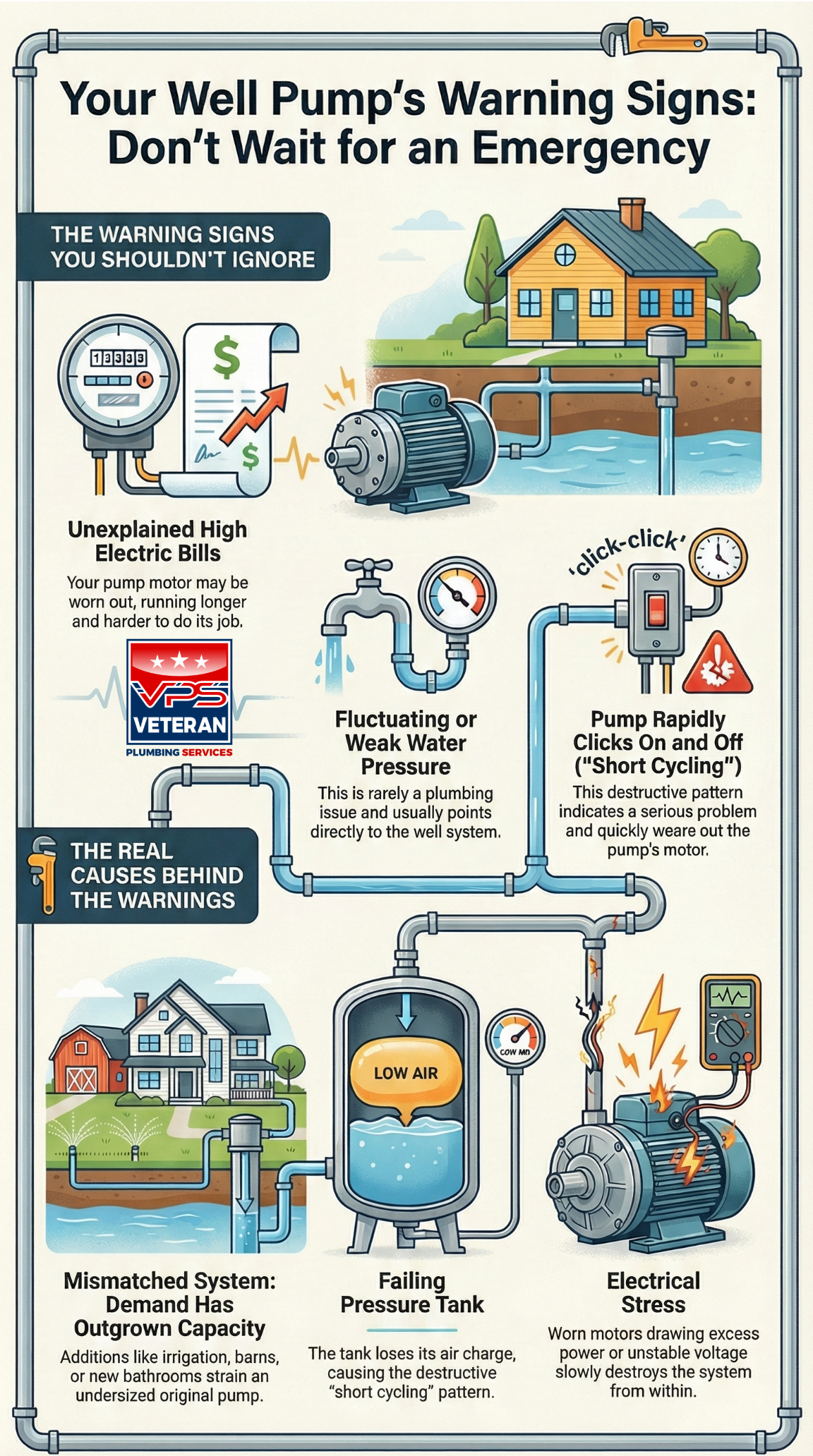
Table of Contents
- Chapter One: Western and Northwestern Fauquier County
- Chapter Two: Central Fauquier County
- Chapter Three: Southern Fauquier County
- Chapter Four: Town Edge and Transition Zones
- Chapter Five: Agricultural and Estate Properties
- Chapter Six: Power Reliability and Emergency Planning
- Chapter Seven: The Common Mistakes I See
- Final Chapter: Protecting Your Well System Long Term
Chapter One
Western and Northwestern Fauquier County
Marshall, The Plains, Rectortown, Hume, and the surrounding rural corridors
I am Dennis Rollins, owner of Veteran Plumbing Services, and I have spent years working on well systems across Western and Northwestern Fauquier County. This part of the county is beautiful, open, and rural, just like our Culpeper County neighbors. It is also one of the most demanding environments for a private well pump system anywhere in Northern Virginia.
Homes in and around Marshall, The Plains, Rectortown, and Hume are almost entirely dependent on private wells. There is no backup water source. When the pump struggles, the entire home feels it.
Why well systems work harder in this region
Western Fauquier is not flat suburban land. The terrain is rolling and rocky. Wells are often deep, sometimes several hundred feet, and water must be lifted uphill to reach large homes set far back from the road. That means the pump works longer and harder every single day.
Most properties here also sit on large parcels. Long water lines between the well and the house increase friction loss. That alone can reduce pressure and increase pump run time even when nothing is technically broken.
Large homes create hidden demand problems
Many homes in this region are custom built. Multiple bathrooms, large soaking tubs, walk in showers, irrigation systems, barns, and guest houses are common.
The mistake I see over and over is this: The original well pump was sized for the house when it was first built. Over time, the home grows. A bathroom is added. Landscaping irrigation is installed. A barn or workshop is tied into the same well. The pump never gets upgraded. The result is a system that technically works but is constantly operating at its limit.
Electrical load is the silent killer
This is one of the biggest problems unique to Western Fauquier. Deep wells require larger pump motors. Larger motors draw more electricity. When the pump is undersized or worn out, it runs longer to do the same job. Homeowners notice higher electric bills long before they notice water problems.
I regularly test pumps in this area that are pulling excessive amperage because the motor is worn, the voltage is unstable, or the pressure system is short cycling. That wasted power adds up month after month.
Pressure problems are often misdiagnosed
Homeowners call me saying they have low pressure or fluctuating pressure. Many assume it is a plumbing issue inside the house. In this region, it is usually one of three things:
- A pressure tank that has lost its air charge and is causing rapid pump cycling.
- A pump that is too small for the current demand of the property.
- Excessive friction loss from long underground water lines combined with elevation changes.
Replacing fixtures will not fix these problems. The well system has to be evaluated as a complete system.
Agricultural and estate water use changes everything
This region has horse farms, vineyards, and large estates. Water is not just used for showers and sinks. It is used for livestock, irrigation, wash down areas, and outbuildings.
When those systems turn on, household pressure drops instantly if the pump and pressure tank are not properly sized. I have seen homes lose pressure every time an irrigation zone activates because the system was never designed to handle simultaneous demand.
Power outages are more dangerous here
Western Fauquier experiences more frequent and longer power outages than town centered areas. When the power goes out, the pump stops. No water. No toilets. No showers. No fire protection.
I also see damage caused by improper generator hookups. Pumps are sensitive to voltage and frequency. A poorly connected generator can destroy a pump motor in minutes. Emergency planning is not optional in this part of the county. It is necessary.
The warning signs I tell homeowners not to ignore
If you live in this region and rely on a well, these signs matter:
- Your electric bill keeps rising with no clear explanation.
- Pressure drops when multiple fixtures are used.
- The pump turns on and off rapidly.
- Water pressure feels fine one day and weak the next.
- You hear clicking or buzzing near the pressure switch.
These are not minor issues. They are early warnings of pump failure.
Why proactive inspections matter more here than anywhere else
In Western and Northwestern Fauquier, a failed well pump is not an inconvenience. It is a full loss of water. Emergency replacements are expensive. Repairs are harder. Parts availability matters. Planning ahead saves thousands of dollars and prevents weeks of stress.
This region demands properly sized equipment, stable electrical supply, and regular system evaluations. When everything is balanced correctly, these systems can run reliably for years. When they are not, failure is inevitable.
In the next chapter, I will move into Central Fauquier County and explain why rural subdivisions and older wells create a completely different set of problems, even though the homes may look closer together.
Chapter Two
Central Fauquier County
Casanova, Midland, Calverton, Orlean, and surrounding rural communities
Central Fauquier County presents a very different set of well pump challenges than the wide open western side of the county. On the surface, many of these areas look easier. Homes are closer together. Roads are paved. Subdivisions feel established. But beneath the ground, these well systems are often under more stress than homeowners realize.
Homes in Casanova, Midland, Calverton, and Orlean rely almost entirely on private wells. Many of these systems were installed years ago, sized for smaller families, fewer bathrooms, and much lower daily water demand.
Older well systems meeting modern living
A large percentage of homes in Central Fauquier were built twenty to forty years ago. At the time, one or two bathrooms was normal. Water use was predictable. Builders installed modest pumps and pressure tanks that worked fine for decades.
Then life changed. Families grew. Bathrooms were added. Kitchens were renovated. High flow showers replaced older fixtures. Washing machines got larger. Dishwashers became standard. The well system stayed the same. This mismatch is one of the most common problems I see in this part of the county.
Short cycling is everywhere here
If I had to name the single biggest issue in Central Fauquier, it would be short cycling. Short cycling happens when the pressure tank no longer holds the proper air charge. The pump turns on and off rapidly instead of running smoothly. This wears out motors fast and drives electric bills up quietly.
Homeowners often hear it but do not recognize it. The pump clicks on. Shuts off. Turns back on seconds later. That pattern might happen dozens of times during a single shower. In Central Fauquier, I replace failed pressure tanks constantly. Many are long past their expected service life.
Sediment and iron create hidden damage
This area is known for groundwater that carries sediment and iron. Even when water looks clear, those particles move through the system every day. Sediment wears down pump impellers. Iron builds up on pressure switches. Filters clog faster than homeowners expect. Flow drops. Pressure drops. The pump works harder to compensate.
Electric bills tell the story first
In Central Fauquier, homeowners often call me because of rising electric bills, not water complaints. The pump still works. Water still flows. But the system is running longer and cycling more often to meet demand. A worn pump motor pulling excessive amperage can add real money to a monthly power bill. Over a year or two, that wasted energy often costs more than the repair that would have fixed the problem early.
Additions and renovations push systems past their limit
Finished basements are common here. So are added bathrooms and laundry rooms. I routinely find well systems that were never reevaluated after these upgrades. The pump was never resized. The pressure tank was never upgraded. The electrical supply was never checked.
The homeowner experiences weak pressure upstairs, slow filling tubs, or pressure drops when multiple fixtures run. These are system capacity issues, not plumbing leaks.
Seasonal demand makes problems worse
Central Fauquier wells feel the strain most in summer. Lawns are watered. Kids are home. Laundry runs more often. Showers increase. If the system is already marginal, summer pushes it over the edge. That is when pumps overheat, pressure switches fail, and emergency calls spike.
Warning signs specific to this region
If you live in Central Fauquier and rely on a well, these symptoms deserve attention:
- The pump turns on and off rapidly
- Pressure drops when two fixtures run at once
- Filters clog unusually fast
- Water pressure feels inconsistent day to day
- Electric bills rise without explanation
Why inspections save money here
In this part of the county, most failures are not sudden. They are slow, predictable breakdowns caused by age and demand creep. A proper inspection looks at the pump performance, pressure tank condition, electrical draw, and water quality together. When addressed early, repairs are manageable. When ignored, they turn into full pump replacements during peak season.
In the next chapter, I will move south toward Remington and the surrounding rural corridors, where shallow wells and seasonal water table changes create a different and often more urgent set of risks for homeowners.
Chapter Three
Southern Fauquier County
Remington and the surrounding southern rural zones
Southern Fauquier County is where I see some of the most misunderstood well pump problems in the entire county. On paper, these homes appear close to town. In reality, the moment you step outside the limits of Remington, you are living on a private well system that behaves very differently from what most homeowners expect.
Living near town does not mean town water
One of the biggest misconceptions in Southern Fauquier is the belief that proximity to Remington means reliable water infrastructure. It does not. Public water stops quickly at town boundaries. Outside those limits, homes are fully dependent on wells that were often added after the house was built or sized quickly to meet minimum requirements. That gap between expectation and reality leads to a lot of frustration.
Shallow wells create seasonal instability
Many wells in this region are shallower than those in Western Fauquier. That makes them more sensitive to seasonal water table changes. During wet months, everything seems fine. Pressure feels steady. Pumps cycle normally. Then summer hits.
Extended dry periods lower the water table. Pumps have to work harder to pull the same amount of water. Recovery rates slow. Pressure drops become noticeable during peak use times like mornings and evenings. This is when pumps overheat, pressure switches burn out, and homeowners suddenly lose water with no warning.
Drought stress exposes weak systems
Southern Fauquier wells reveal their weaknesses during drought conditions. A properly sized and healthy system can tolerate moderate water table drops. An aging or undersized system cannot. I see pumps running continuously trying to recover water. Motors overheat. Electrical draw spikes. Eventually, something gives. These failures often happen during heat waves when demand is highest and service calls are hardest to schedule.
Homes added faster than infrastructure
Southern Fauquier has seen steady growth. Many homes were built quickly on rural lots with minimal planning for long term water demand. Builders installed entry level pumps and small pressure tanks to meet code. They worked fine at first. Years later, families grow. Water use increases. Landscaping is added. The system never gets upgraded. What worked in year one becomes a liability in year ten.
Pressure complaints point to capacity problems
Low pressure in this region is rarely caused by plumbing inside the house. More often, it is caused by:
- Pumps that cannot keep up during peak use
- Pressure tanks that are too small
- Wells that cannot recover fast enough in dry conditions
Replacing faucets or showerheads does not fix these problems. The well system must be evaluated as a whole.
Electrical stress accelerates pump failure
Shallow wells still rely on electric motors, and when water levels drop, those motors work harder. I regularly measure increased amperage draw on pumps in this area during summer months. That extra load increases heat, shortens motor life, and drives up electric bills. Homeowners often notice power cost increases before they experience total water loss.
Emergency failures are more common here
Southern Fauquier produces a high number of emergency well calls. Why? Seasonal demand spikes, heat related motor failures, aging pressure tanks, and limited redundancy. When a pump fails here, there is no backup water source. The house is immediately without water.
Warning signs specific to Southern Fauquier
If you live near Remington and rely on a well, these signs deserve attention:
- Pressure drops during hot weather
- Long pump run times
- Water sputtering during heavy use
- Sudden changes in pressure from day to day
- Rising electric bills during summer
Planning ahead matters more here than most areas
Because shallow wells are sensitive to weather and seasonal demand, proactive planning makes a major difference. That means confirming pump capacity, verifying pressure tank sizing, monitoring electrical draw, and preparing for drought conditions. Addressing these issues before summer arrives can prevent emergency failures and costly replacements.
In the next chapter, I will focus on town edge and transition zones around Warrenton, Bealeton, Marshall, and The Plains, where homeowners are often caught between municipal expectations and rural reality.
Chapter Four
Town Edge and Transition Zones
Outside Warrenton, Bealeton, Marshall, and The Plains town limits
This chapter is for homeowners who live just outside town limits in Fauquier County. These are some of the most misunderstood well pump environments I work in because they sit in a gray zone between town life and rural reality. Homes near Warrenton, Bealeton, Marshall, and The Plains often look suburban. Paved roads. Sidewalks nearby. Neighbors close enough to wave at. But once you step outside town boundaries, the water system changes completely.
The expectation gap causes the most frustration
Homeowners in these transition zones often assume their water system behaves like town water. It does not. There is no municipal pressure regulation. No constant supply. No infrastructure team monitoring flow. Everything depends on a private pump, pressure tank, and electrical system working together. When pressure drops or water runs out, the confusion sets in fast.
Builder grade well systems are common here
Many homes just outside town limits were built quickly as development pushed outward. Builders installed the minimum required well equipment to pass inspection. That usually means:
- Small pressure tanks
- Entry level pumps
- Minimal electrical planning
- No allowance for future demand
These systems work fine when the house is new. Over time, they struggle.
Pressure complaints are often misdiagnosed
This is one of the most common service calls I get in these areas. Homeowners report weak showers, pressure drops when a toilet flushes, slow filling tubs, or inconsistent flow upstairs. They assume something is wrong inside the house. In reality, the well system is cycling too often or cannot keep up with demand. Replacing fixtures will not fix it.
Rapid cycling shortens pump life
Small pressure tanks fill and empty quickly. That forces the pump to turn on and off repeatedly throughout the day. Each start creates electrical stress and heat. Over time, that destroys pump motors. I see pumps in these zones fail years earlier than they should because the system was never designed for how the home is actually used.
Electrical systems are rarely evaluated
In town edge homes, electrical panels and wiring are often never checked when well problems arise. A pump pulling excessive amperage due to wear or voltage drop will still move water, but it quietly wastes electricity and builds heat. Homeowners notice higher power bills long before the pump stops working.
Landscaping and irrigation change everything
One sprinkler zone can pull more water than an entire household. In town edge areas, irrigation systems are frequently added without upgrading the well system. When irrigation runs, household pressure collapses. This creates complaints that seem random unless the system is evaluated as a whole.
Warning signs specific to transition zones
If you live just outside town limits and rely on a well, these symptoms matter:
- Pressure fluctuates throughout the day
- The pump runs every time a faucet is used
- Water pressure drops when irrigation turns on
- Electric bills rise slowly over time
- Pressure problems worsen as the house ages
Why town edge systems fail quietly
Unlike deep rural systems that show obvious strain, town edge well systems fail gradually. They work just well enough to hide the problem until a motor burns out, a pressure tank ruptures, or the system cannot meet demand anymore. By the time water stops completely, the damage is already done.
Planning for the reality of rural water
Homes outside town limits need to be treated like rural properties, even if they feel suburban. That means proper pump sizing, adequate pressure tank capacity, electrical performance testing, and planning for irrigation demand. When these systems are balanced correctly, pressure stabilizes, pumps last longer, and electric bills drop.
In the next chapter, I will move into agricultural and estate properties across Fauquier County, where water demand goes far beyond household use and a single system failure can shut everything down at once.
Chapter Five
Agricultural and Estate Properties
Farms, vineyards, equestrian facilities, and large acreage estates
Agricultural and estate properties across Fauquier County place the highest demands on private well systems anywhere in the region. These properties are beautiful and expansive, but they are also unforgiving when a well system is not engineered correctly. Here, water is not just for daily living. It is for operations.
One well often serves everything
On many farms and estates, a single well supplies:
- The main residence
- Guest houses or tenant quarters
- Barns and wash stalls
- Irrigation systems
- Outbuildings and workshops
When that one system falters, everything stops at once. This is where I see the most expensive emergency failures because the consequences ripple across the entire property.
Demand is constant and unpredictable
Unlike residential homes with predictable morning and evening peaks, agricultural properties draw water throughout the day. Horses need water, irrigation cycles run on schedules, wash downs happen after use, and multiple buildings may draw water at the same time. If the pump and pressure system are not sized for simultaneous demand, pressure drops immediately and recovery times suffer.
High capacity pumps create electrical stress
To meet demand, these properties often use high horsepower pumps. Those motors place significant load on the electrical system. If wiring is undersized, voltage is unstable, or the pump is aging, electrical draw increases and heat builds quickly. I regularly find pump motors running outside their safe operating range because no one ever tested them under real load. Electric bills climb and equipment life drops fast.
Irrigation is the biggest wildcard
Irrigation systems are often added years after the original well was installed. One irrigation zone can exceed the water demand of the house. Multiple zones running together can overwhelm even a strong pump. I see two common mistakes: Irrigation tied into the same well without evaluation, and no priority control between household and irrigation use. The result is pressure collapse indoors whenever irrigation runs.
Water quality challenges are magnified
Agricultural areas often deal with sediment, iron, and mineral heavy water. These conditions wear down pump impellers, clog filters quickly, damage pressure switches, and reduce overall flow. Without proper filtration and maintenance, the entire system degrades faster than homeowners expect.
Long distances increase friction loss
Estate properties often have long underground water lines running hundreds of feet between the well and buildings. Every foot adds friction loss. Elevation changes add even more strain. If the system was not designed with these distances in mind, pressure will always feel marginal even when nothing is broken.
Redundancy is rarely built in
Most agricultural and estate properties rely on a single pump and a single pressure system. When that system fails, there is no water for the home, livestock care becomes difficult, and operations stop immediately. Backup planning is often overlooked until after a failure occurs.
Warning signs I see before major failures
On large properties, these warning signs matter:
- Pressure drops when multiple buildings draw water
- Pumps run for long periods without shutting off
- Electrical panels show heat or breaker stress
- Irrigation causes indoor pressure loss
- Electric bills spike during watering seasons
Why proactive planning matters most here
Agricultural and estate well systems are expensive to repair under emergency conditions. Planned upgrades allow proper pump sizing, larger pressure tanks, electrical system corrections, and demand management strategies. When done correctly, these systems run smoothly and reliably. When ignored, failures are sudden and costly.
In the next chapter, I will focus on power reliability and emergency planning across Fauquier County, explaining what really happens when the power goes out and how to protect your well system before a storm or outage leaves you without water.
Chapter Six
Power Reliability and Emergency Planning
What really happens when the power goes out
This chapter applies to every homeowner on a private well in Fauquier County, no matter where you live. If your water comes from a well, electricity is not optional. The moment the power stops, your water stops too. This is the reality many homeowners do not fully grasp until they are already in the dark.
No power means no water. Immediately.
A private well has no stored supply unless the system is designed for it. When the power goes out, the pump shuts off, pressure drops quickly, toilets stop refilling, and faucets run dry. There is no grace period. There is no reserve unless you planned for one. In rural areas of Fauquier County, outages often last longer than people expect. Trees come down. Lines are damaged. Repairs take time.
Pressure tanks are not water storage
This is one of the biggest misconceptions I hear. A pressure tank does not store usable water in any meaningful quantity. It stores pressure. Once that pressure is used, the tank is empty. In most homes, you may get a few toilet flushes and maybe a quick hand wash before the system is completely dry.
Winter outages create serious risks
Cold weather outages are especially dangerous for well homes. Without water, you cannot run heat systems that rely on water, you cannot protect pipes from freezing, and you cannot respond to leaks or bursts. I have seen frozen pipes turn into major floods simply because homeowners could not restore water pressure in time once power returned.
Generators are often installed incorrectly
Many homeowners invest in generators and assume they are protected. Unfortunately, I see generator related pump damage every year. Common mistakes include incorrect voltage, unstable frequency, improper transfer switching, and pumps wired without load evaluation. Well pumps are sensitive equipment. A generator that is not properly matched and connected can destroy a pump motor in minutes.
Soft starts and electrical compatibility matter
Modern well systems often benefit from soft start devices and proper electrical balancing. These components reduce startup amperage, protect motors during generator operation, extend pump life, and reduce stress on electrical panels. Skipping this step to save money often leads to far more expensive failures later.
Long outages expose system weaknesses
Extended outages reveal problems that were already there. Pressure tanks that have lost charge, pumps that struggle to restart, weakened electrical connections from heat, and control boxes nearing failure. When power returns, these components are hit with a sudden load. Weak systems fail at that moment, not during the outage itself.
Emergency water planning is not overkill
Every well-dependent home should have a basic emergency plan. That includes knowing exactly how your well is powered, understanding generator capacity and limitations, having limited stored water for critical use, and protecting pipes during cold outages. This is not panic planning. It is responsible ownership.
Warning signs your system is not outage ready
If any of these apply, your system needs evaluation:
- The pump struggles to restart after outages
- Breakers trip when power returns
- Pressure takes a long time to recover
- Generator stalls or surges under pump load
- Electrical panels show signs of heat or wear
Why outage planning saves money
Most catastrophic well failures I respond to happen after storms, after extended outages, or during extreme temperatures. Planning ahead prevents emergency replacements, protects electrical systems, and keeps your household functioning when conditions are at their worst.
In the next chapter, I will break down the most common mistakes I see across every region of Fauquier County. These are the same errors that quietly shorten pump life, raise electric bills, and lead to avoidable emergencies.
Chapter Seven
The Common Mistakes I See
Why well systems fail early and how homeowners unintentionally cause it
No matter where I work in Fauquier County, the same mistakes keep showing up. These issues are not tied to one town or one neighborhood. They are patterns that quietly shorten the life of well systems and drive up costs for homeowners who never realized something was wrong. Most of these problems are preventable.
Treating pressure problems like plumbing problems
This is the most common mistake I see. Homeowners replace faucets, showerheads, and cartridges trying to fix pressure issues. The problem is almost never inside the house. Low or fluctuating pressure is usually caused by undersized pumps, failing pressure tanks, excessive pump cycling, or electrical supply issues. Without evaluating the well system as a whole, money gets spent in the wrong places.
Ignoring electrical performance
A well pump is an electric motor first and a water system second. If voltage is low, amperage is high, or wiring is undersized, the pump will still move water but it will destroy itself slowly. Many homeowners never realize their electric bill is telling the story. Rising power costs are often the first warning sign of a failing pump motor.
Allowing short cycling to continue
Short cycling is not annoying. It is destructive. Every time a pump starts, it experiences heat and electrical stress. When a pressure tank fails and allows rapid cycling, the motor wears out fast. I routinely replace pumps that should have lasted years longer because a bad pressure tank was ignored.
Adding demand without upgrading the system
Homes change over time. Bathrooms are added, basements are finished, irrigation is installed, and outbuildings are connected. The well system stays the same. This mismatch leads to pressure complaints, long run times, and premature pump failure. Any major home upgrade should trigger a well system evaluation.
Assuming town proximity equals town reliability
Living near a town does not mean you have town water performance. Outside town limits, you are responsible for everything. Pressure regulation, system maintenance, electrical supply, and emergency planning all fall on the homeowner. This misunderstanding leads to unrealistic expectations and delayed action.
Waiting for total failure
Many homeowners wait until water stops completely before calling for help. By then, the pump motor may be burned out, electrical components may be damaged, emergency replacement costs are higher, and scheduling options are limited. Early intervention saves money and stress.
Skipping routine inspections
Well systems are often forgotten because they are out of sight. Without periodic inspection, small issues grow into major failures, efficiency drops unnoticed, electrical stress increases, and system life shortens. A simple evaluation every few years can prevent thousands of dollars in repairs.
Believing wells are set and forget systems
A well system is mechanical and electrical equipment. Like any system, it ages and changes. Ignoring it does not make it reliable. It makes failure unpredictable. Understanding how your system works puts control back in your hands.
Why these mistakes repeat across the county
Most homeowners were never educated about their well system. Builders install them. Inspectors approve them. Then no one explains how they behave over time. That knowledge gap is why the same failures repeat across different regions and property types.
In the final chapter, I will explain how I help homeowners protect their well systems long term. This includes how to recognize early warning signs, when repair makes sense, and when replacement is the smarter investment.
Final Chapter
Protecting Your Well System Long Term
How I help homeowners prevent failures, reduce power costs, and stay in control
Everything in this guide leads to one goal: helping homeowners in Fauquier County avoid the stress and expense that come from unexpected well pump failures. A well system does not fail overnight. It gives warning signs. The key is knowing what to look for and acting before those warnings turn into emergencies.
I start by evaluating the entire system
I do not look at just the pump. A well system only works when every part works together. That includes pump performance and capacity, pressure tank condition and sizing, electrical draw and voltage stability, pressure switch operation, and water quality impact on components. This full system approach is what separates temporary fixes from lasting solutions.
I focus on efficiency as much as reliability
A system that works but wastes electricity is still a problem. By measuring amperage and run time, I can identify pumps that are costing homeowners money every month. Improving efficiency often lowers electric bills while extending equipment life. Many homeowners are surprised to learn their power savings alone can offset the cost of corrective work.
I help homeowners understand repair versus replacement
Not every issue requires a full pump replacement. Sometimes a pressure tank replacement restores proper operation, electrical corrections reduce stress on the motor, or system adjustments stabilize pressure. When replacement is the smarter option, I explain why in plain language so homeowners can make confident decisions.
I plan for future demand, not just today
Homes change. Families grow. Water use increases. I size systems with room to grow so homeowners are not forced into another upgrade a few years later. This is especially important in rural and estate properties. Planning ahead costs less than reacting later.
I address power outage readiness
If your well depends on electricity, outage planning matters. I help homeowners understand generator compatibility, protect pump motors from voltage damage, prepare for extended outages, and avoid cold weather pipe failures. This planning turns emergencies into manageable situations.
I emphasize education, not pressure
My goal is not to sell equipment. It is to give homeowners the knowledge to protect their water system. When homeowners understand how their well works, they make better decisions and avoid unnecessary expenses.
Why local experience matters
Fauquier County is not uniform. Western rural properties behave differently than town edge homes or central subdivisions. Local experience means knowing how soil conditions, water tables, housing patterns, and electrical infrastructure affect well systems in specific areas. That knowledge makes the difference between guessing and solving the problem correctly.
The bottom line
Your well system is one of the most important pieces of your home. When it fails, daily life stops. Understanding how your system works, recognizing warning signs early, and planning for the realities of rural water ownership protects your investment and your peace of mind. This guide was written to give you that understanding before a failure forces the issue. If you rely on a private well and want clarity about your system, the right time to address it is before the water stops flowing.
📞 Call Veteran Plumbing Services today at 703-791-1339
I’m Dennis Rollins. I served my country, and now I’m here to help you protect your home.
📞 Schedule online Veteran Plumbing Services Anytime — 24 hours a day.