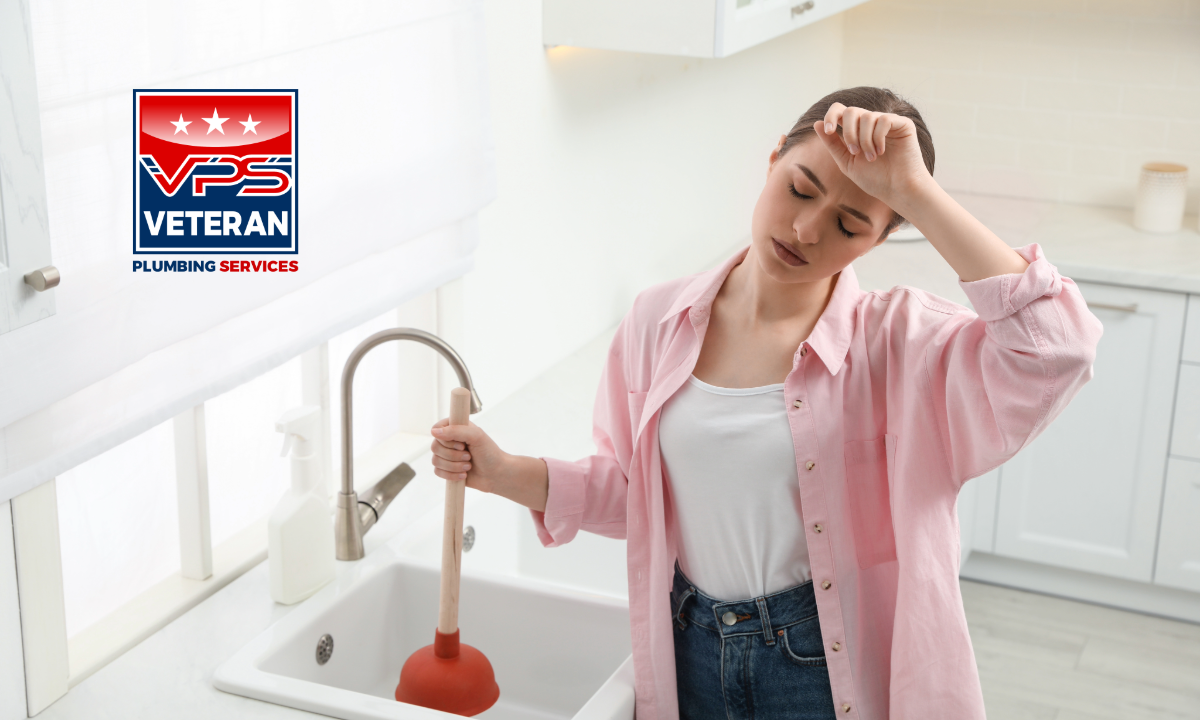
Winter cooking in Leesburg is serious business. Holiday meals, warm soups, roasted meats, and all the cleanup that follows. The problem is that the same season that brings your kitchen to life is the season that does the most damage to your kitchen drain. Cold temperatures outside mean cooler pipe temperatures inside your walls, and the fats and grease you pour down the sink solidify faster and adhere more stubbornly to the pipe walls than at any other time of year. By February, many Leesburg homeowners are dealing with a drain that barely moves — and wondering how it got this bad.
Kitchen Drain Moving Slowly in Leesburg?
Veteran Plumbing clears kitchen drain clogs throughout Leesburg and all of Loudoun County — same-day service available.
Or call: 703.791.1339
Why Winter Is the Worst Season for Kitchen Drain Clogs in Leesburg
Leesburg sits in northern Loudoun County where winter temperatures regularly drop into the teens and single digits. When outside temperatures fall that far, the soil around your sewer lateral gets cold, and the pipes running through your exterior walls drop well below the temperature at which cooking fats remain liquid. Grease that might have made it further into the drain system in July sticks right at the wall surface in January.
The result is a progressive buildup that narrows the pipe interior with every winter meal. Homeowners often notice the problem after Thanksgiving and again after Christmas — two of the highest-grease-volume cooking periods of the year. By the time January arrives, the drain has slowed to a trickle.
The Specific Grease Offenders in Leesburg Kitchens
- Roasting drippings poured down the drain after cooling — still liquid but already coating pipe walls on contact
- Bacon and sausage fat that gets rinsed off a pan with hot water, which carries it far enough to seem harmless before it cools and solidifies
- Butter and cream sauces rinsed from cookware — lighter than heavier oils but still solidifying in cold pipes
- Garbage disposal food waste that includes starchy sides and holiday leftovers, compacting into a dense mass at bends in the drain line
What Grease Buildup Actually Looks Like Inside a Leesburg Drain Pipe
A drain pipe that has processed five or ten winters of cooking grease does not look like a smooth, clear cylinder. It looks like a pipe where the interior diameter has been reduced by a progressively thickening coating of yellow-white solidified fat, embedded with food particles and reinforced by soap scum and hard water mineral deposits. Leesburg’s water is moderately hard, which means the calcium content bonds with grease residue and makes the buildup harder and more resistant to hot water than it would be in a soft-water area.
When that coating reaches a certain thickness, the drain slows noticeably. When it reaches a complete ring around the interior of the pipe, the drain stops. At that point, liquid drain cleaners will not touch it — the chemical cannot penetrate a hardened grease-mineral matrix — and a plunger will not move it.
The Right Fix: Hydro Jetting for Grease-Clogged Kitchen Drains
Hydro jetting uses a pressurized water stream delivered through a rotating nozzle that sprays in multiple directions simultaneously. It strips the full circumference of the pipe interior clean — not just punches a hole through the clog the way a drain snake does. After a hydro jetting service, the pipe flows as it did when it was new. The coating is gone, not just breached.
For Leesburg kitchen drains with heavy winter grease accumulation, hydro jetting is consistently the most effective solution. It is also the only method that addresses the pipe wall coating rather than the soft clog in the center of it. Read more about what builds up inside drain pipes in our guide: What’s Really Living Inside Your Pipes.
How to Protect Your Leesburg Kitchen Drain This Winter
- Let all cooking fats cool completely, then transfer to a jar and dispose in the trash
- Wipe pans with a paper towel before washing to remove grease before it reaches the drain
- Run cold water — not hot — when using the garbage disposal; cold water keeps fats solid so they can be chopped and pass through rather than liquefying and coating the pipe
- Pour an enzyme drain cleaner down the kitchen drain once a month to break down organic buildup before it accumulates
- Schedule a professional kitchen drain cleaning before the holiday cooking season — not after
For a deeper look at why fats and grease cause so much damage to drain systems, see our full resource: Keep Fats, Oils, and Grease Out of Your Drains.
Don’t Wait Until It Stops Completely
A slow kitchen drain in January means a blocked kitchen drain by February. Veteran Plumbing serves all of Leesburg and Loudoun County with fast, honest drain service.
Frequently Asked Questions About Kitchen Drain Clogs in Leesburg, VA
Does cold weather really make kitchen drain clogs worse in Leesburg?
Yes, measurably so. Cooking fats solidify at temperatures between 65°F and 90°F depending on the type. In winter, your drain pipes — especially those running through exterior walls or under a crawl space — can drop well below that range, causing grease to solidify almost immediately rather than traveling further into the system where it is less likely to cause an obstruction.
Why doesn’t hot water fix a grease clog in my Leesburg kitchen drain?
Hot water melts the outermost layer of a grease clog but pushes it further down the pipe rather than removing it. The dissolved grease re-solidifies at the next cool section. Running hot water regularly may slow accumulation slightly, but it does not clear an established grease buildup.
Is it safe to use chemical drain cleaners on a grease clog?
Chemical drain cleaners can loosen a soft grease clog in the first few inches of the pipe, but they cannot penetrate a hardened grease-mineral matrix that has built up over time. Repeated use of chemical cleaners also degrades older pipe materials. For a serious grease clog in a Leesburg kitchen drain, professional hydro jetting is both more effective and safer for the pipe.
How do I know if my kitchen drain clog is in the P-trap or deeper in the pipe?
If the drain is completely blocked and nothing passes, the obstruction is likely at or near the P-trap — accessible by removing the trap under the sink. If the drain is slow but still moves water, the buildup is more likely distributed along a longer section of pipe and requires hydro jetting to clear effectively.
Does Veteran Plumbing serve all of Leesburg, including the newer neighborhoods?
Yes. Veteran Plumbing serves all of Leesburg, including Lansdowne, River Creek, and the Route 15 corridor, as well as communities throughout Loudoun County.
Veteran Plumbing — Leesburg’s Drain Cleaning Specialists
Hydro jetting, drain camera inspection, and same-day service throughout Loudoun County.