
BLUF (Bottom Line Up Front)
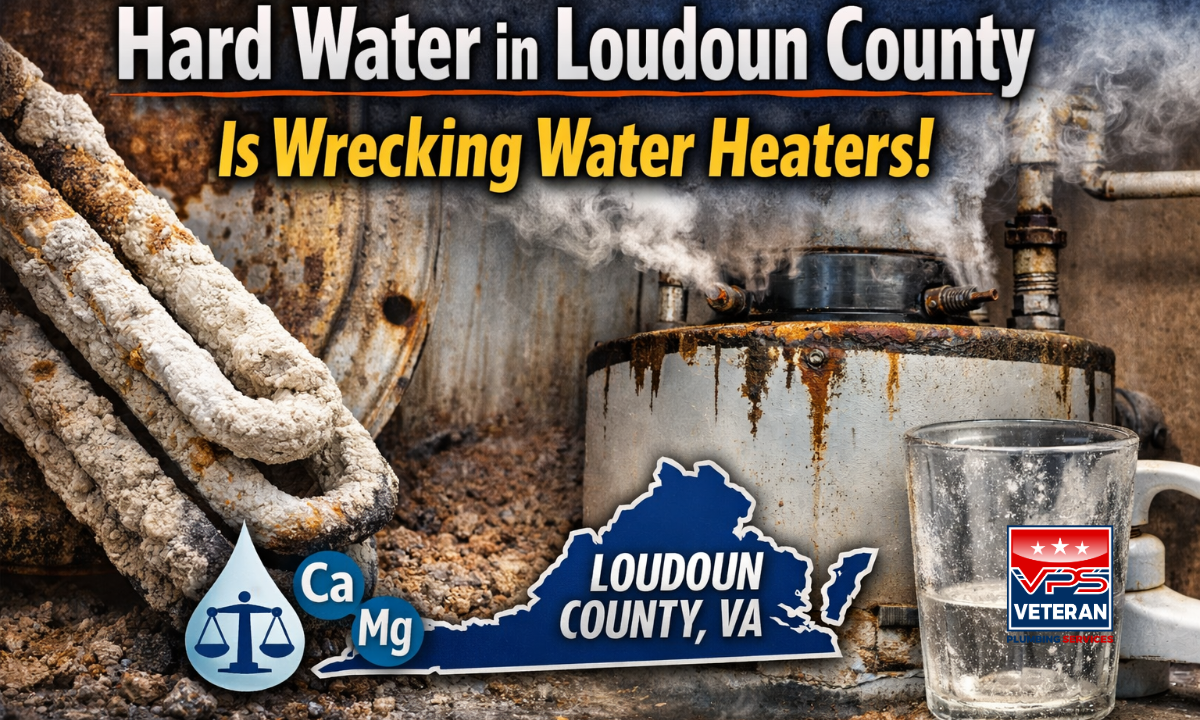
I see this problem all the time in Loudoun County. Homeowners think the water heater failed early, but the real story is often mineral-heavy water, sediment buildup, scale on heating surfaces, and years of neglected maintenance. Loudoun County itself offers household water testing that includes hardness, iron, manganese, total dissolved solids, and other key parameters. Loudoun Water also says white residue on fixtures and kitchenware commonly comes from dissolved minerals, and it specifically notes that calcium and phosphate can build up in the water heater and on household surfaces.
Why this is such a Loudoun County issue
I do not like writing generic plumbing articles. This one needs to be local and practical.
In Loudoun County, you have a mix of homes with public water and those with private wells. Loudoun Water says its customers receive drinking water from the Potomac River and Goose Creek. At the same time, both the Virginia Department of Health and the EPA make clear that private well owners are responsible for their own water quality, and private wells are not regulated under the federal Safe Drinking Water Act in the same way public systems are. That matters because many Loudoun homeowners, especially outside denser service areas, may be dealing with hardness, iron, manganese, or sediment conditions that do not show up until appliances start paying the price.
Loudoun County’s own Household Water Quality Testing Program is a big clue here. The county does not just test for bacteria and lead. It also tests for hardness, iron, manganese, sulfate, pH, sodium, copper, and total dissolved solids. Counties do not build low cost public testing programs around imaginary problems. They build them around the issues residents actually face.
What hard water actually is
Hard water is not some vague plumbing buzzword. The U.S. Geological Survey defines water hardness as the amount of dissolved calcium and magnesium in water. Those minerals are not usually a health emergency. The plumbing problem is what they do after years of moving through a house, especially after they get heated.
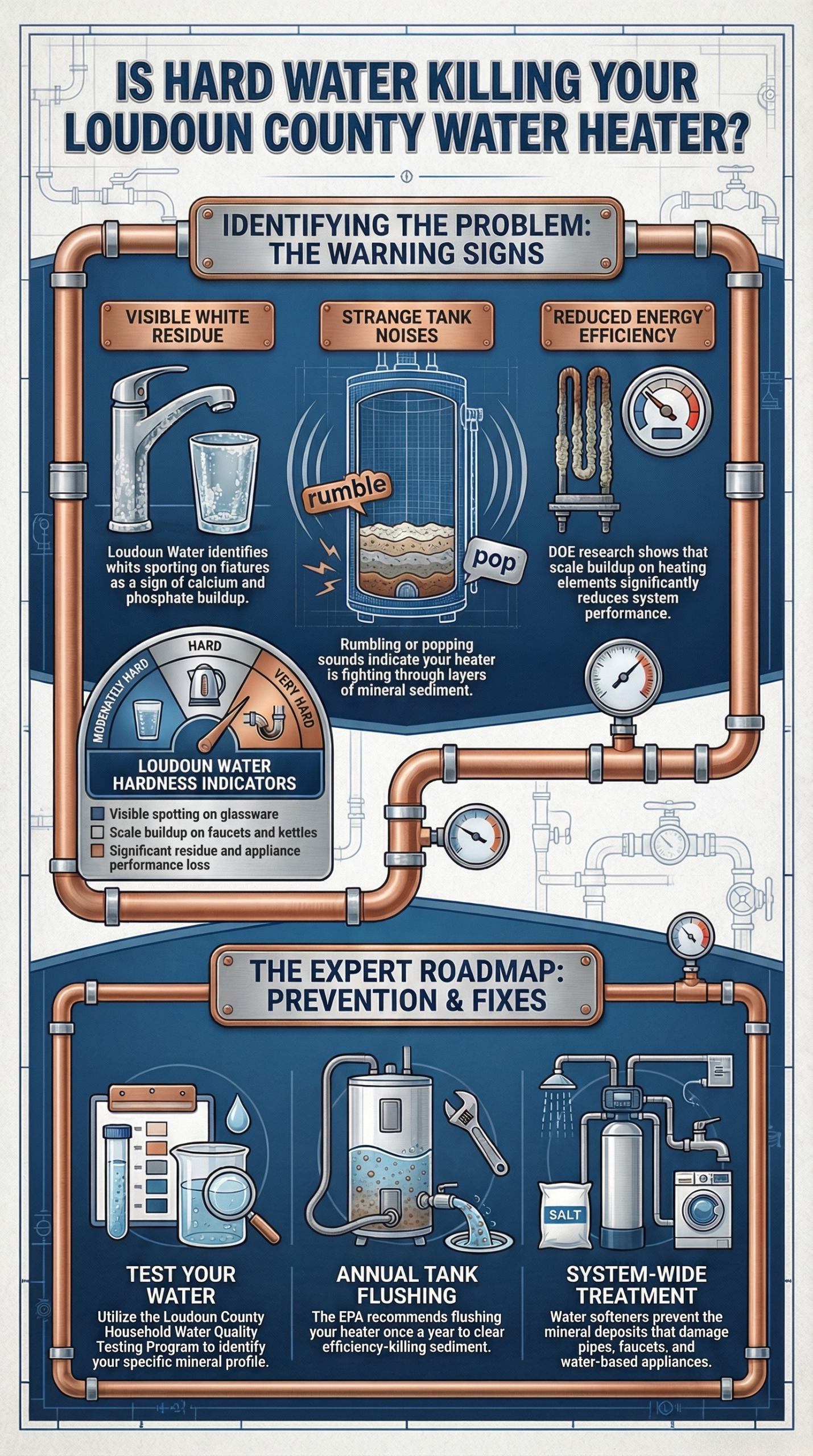
Loudoun Water has even published a hardness scale that classifies water as slightly hard, moderately hard, hard, or very hard based on grains per gallon and milligrams per liter. That matters because homeowners often treat white spotting, cloudy glassware, and chalky residue as cosmetic annoyances when they are really warning signs that mineral load is building up in plumbing fixtures and water heating equipment.
Why water heaters take the hit first
A water heater is where I expect hard water damage to show itself early because heat accelerates the problem.
EPA WaterSense technical guidance states that hard water can cause scale to form inside pipes, water heaters, appliances, and equipment, and it notes that scale does not conduct heat well. The Department of Energy also states that hard water can cause calcium scale deposits on heat transfer surfaces and that scale buildup reduces system performance. When scale forms between the burner or heating element and the water you are trying to heat, the system has to work harder to do the same job.
That is one reason homeowners call me and say, “My hot water does not last,” or “The water heater sounds like it is popping or rumbling.” In plain English, the tank is often full of mineral sediment and scale. The heater is still trying to do its job, but it is fighting through a layer of junk that should not be there. EPA also advises flushing a water heater once a year to reduce sediment buildup because sediment can decrease efficiency.
The hidden cost most homeowners miss
A lot of people think hard water is only about spots on dishes or soap not lathering well. That is the surface level issue. The real cost is what happens inside the equipment you cannot see.
The EPA WaterSense manual says hard water can reduce water flow through pipes and fixtures. DOE research on real world water heater performance found the largest performance decline in one electric unit that had significant scaling on the heating elements, and the report notes that scaling in hard water areas could reduce energy efficiency. In other words, hard water is not just ugly. It can make your equipment slower, less efficient, and more expensive to run.
I tell homeowners this all the time. If your utility bill is climbing, your shower goes lukewarm faster, and the heater is making noise, you may not have a bad brand or a defective install. You may have a water quality problem that has been chewing up the unit from the inside for years. That is a different diagnosis, and it leads to a different long term fix. This conclusion is consistent with EPA and DOE guidance on scale, sediment, and efficiency loss in hard water conditions.
The Loudoun County signs I want homeowners to notice
In Loudoun County, I pay close attention when homeowners tell me they are seeing white residue on glassware, shower doors, faucets, or inside kettles. Loudoun Water says this white residue commonly comes from dissolved minerals such as calcium and phosphate, that hardness is often higher during warmer months, and that calcium and phosphate can build up in the water heater and on household surfaces.
If you are on a private well, I pay even closer attention. The Virginia Department of Health says private water system owners have to take care of regular testing and treatment themselves, and the EPA says private well owners are responsible for delivering safe drinking water to their households. Loudoun County’s low cost testing program specifically includes hardness, iron, and manganese, which are exactly the kinds of nuisance issues that can wreck fixtures and appliances over time even when homeowners do not think of them as urgent.
Why some water heaters fail “early”
When a homeowner tells me, “This heater was not that old,” I do not automatically blame the manufacturer.
Early failure can come from heavy sediment loading, mineral scale, poor maintenance, or a mismatch between the water chemistry and the protection strategy inside the system. Hard water can also increase stress on valves, fixtures, and connected piping. DOE’s consumer water heater framework emphasizes efficiency measurements such as Uniform Energy Factor and first hour performance, but real world efficiency and recovery can degrade over time when scale and sediment accumulate. EPA and DOE guidance both point to scale as a performance reducing factor.
That means two homeowners can buy similar water heaters and get very different lifespans from them depending on water quality, maintenance habits, and whether the system is protected from scale. In Loudoun County, where both public water hardness symptoms and private well mineral issues show up in local government guidance, that is not theory. That is field reality.
What I recommend before replacing the heater
I do not like replacing one failed water heater with another future problem.
My first recommendation is to stop guessing and test the water. Loudoun County already offers a Household Water Quality Testing Program that covers hardness and several other useful indicators. For private well homes, that is one of the smartest first steps you can take. For homes on public water, it still helps to understand what is happening inside your house, especially if you are seeing residue, scale, or shortened appliance life.
My second recommendation is maintenance. EPA says flushing the water heater once a year helps reduce sediment buildup that can decrease efficiency. That alone will not cure severe hard water, but it is one of the easiest ways to reduce damage over time.
My third recommendation is to think in systems, not just appliances. If you have meaningful hardness, iron, or manganese issues, replacing the water heater without addressing the incoming water condition may only restart the countdown. DOE says water softeners help prevent mineral deposits and scale buildup that damage water based appliances, clogged pipes, and leaky faucets. That does not mean every home needs the same treatment setup, but it does mean the conversation should go beyond “Which heater is cheapest?”
Repair, replace, or treat the water first?
This is where nuance matters.
If the water heater is still structurally sound and the problem is moderate sediment, maintenance may buy you time. If the heater is older, inefficient, noisy, corroded, or not keeping up with demand, replacement may make sense. But if the water coming into the house is the real culprit, treatment has to be part of the discussion or the new heater may follow the same path.
That is why I do not give one size fits all advice. I want to know whether the home is on public water or a private well. I want to know whether the homeowner is seeing white residue, reduced flow, cloudy glassware, noisy water heating, failing fixtures, or repeated appliance issues. Those symptoms align closely with the hardness and scaling effects described by Loudoun Water, USGS, EPA, and DOE.
My honest take for Loudoun County homeowners
If you live in Loudoun County and your water heater is acting up, do not assume the heater is the whole story. Hard water may be the story. On well systems, iron, manganese, and other nuisance water issues may be part of the story too. Loudoun County and Virginia health authorities give you the roadmap here. Test the water. Understand the mineral profile. Maintain the heater. Fix the root cause when needed.
I am Dennis Rollins, owner of Veteran Plumbing Services. When I look at a failing water heater in Loudoun County, I am not only thinking about replacing a tank. I am thinking about why it failed, what your water is doing to the system, and how to keep you from paying for the same mistake twice.
Call Veteran Plumbing Services at 703-791-1339 if you want help figuring out whether you have a water heater problem, a hard water problem, or both.
📞 Call Veteran Plumbing Services today at 703-791-1339
I’m Dennis Rollins. I served my country, and now I’m here to help you protect your home.
📞 Schedule online Veteran Plumbing Services Anytime, 24 hours a day.
References
- U.S. Environmental Protection Agency. (2023). WaterSense labeled homes technical reference manual. U.S. Environmental Protection Agency.
https://www.epa.gov/system/files/documents/2023-08/ws-homes-TechnicalReferenceManual.pdf - U.S. Environmental Protection Agency. (2024). Home maintenance. WaterSense.
https://www.epa.gov/watersense/home-maintenance - U.S. Environmental Protection Agency. (2026). Private drinking water wells.
https://www.epa.gov/privatewells - U.S. Geological Survey. (n.d.). Hardness of water. Water Science School.
https://www.usgs.gov/water-science-school/science/hardness-water - Loudoun County Government. (2026). Household water quality testing program.
https://www.loudoun.gov/5755/Household-Water-Quality-Testing-Program - Loudoun Water. (n.d.). Your drinking water quality.
https://www.loudounwater.org/residential-customers/your-drinking-water-quality - Loudoun Water. (n.d.). Drinking water quality FAQs.
https://www.loudounwater.org/residential-customers/drinking-water-quality-faqs - Loudoun Water. (2011, July). Common drinking water quality customer questions.
https://www.loudounwater.org/sites/default/files/Common%20Drinking%20WQ%20Customer%20Questions_July_2011.pdf - Virginia Department of Health. (2025). Private well program.
https://www.vdh.virginia.gov/environmental-health/private-well-program/ - U.S. Department of Energy. (n.d.). Purchasing and maintaining a water softener. Office of Energy Efficiency and Renewable Energy.
https://www.energy.gov/energysaver/purchasing-and-maintaining-water-softener - U.S. Department of Energy. (n.d.). Solar water heating system maintenance and repair. Office of Energy Efficiency and Renewable Energy.
https://www.energy.gov/energysaver/solar-water-heating-system-maintenance-and-repair - U.S. Department of Energy, Office of Energy Efficiency and Renewable Energy. (2011). Comparison of real world energy consumption to models to improve predictions and expand use of high performance homes and home improvements.