

BLUF — Bottom Line Up Front
Fairfax County has more than 400,000 residential units, a significant share built between 1950 and 1985. The sewer laterals under many of those homes are made from Orangeburg pipe, clay tile, or cast iron — all of which are at or well past their expected service life. The Fairfax County Water Authority manages the mains in the street. Everything from your foundation to that connection point is yours to maintain and replace. Across communities from Annandale to Centreville, McLean to Kingstowne, Springfield to Reston, the same aging infrastructure problem exists underground, invisible and unannounced, until it is not. The question for every Fairfax County homeowner is not whether the pipe will eventually fail. It is whether you find out before the backup or during it.
Fairfax County, Virginia is one of the wealthiest, most educated, and most carefully maintained communities in the United States. Its schools are nationally ranked, its roads are maintained, its parks are well-funded. What does not make the annual budget presentations and the community meeting agendas is the 50 to 70 year old infrastructure running through the soil beneath its most established neighborhoods — infrastructure that was never designed to outlast the century, and that in many homes is operating well past its intended service life without the homeowner knowing it is there at all.
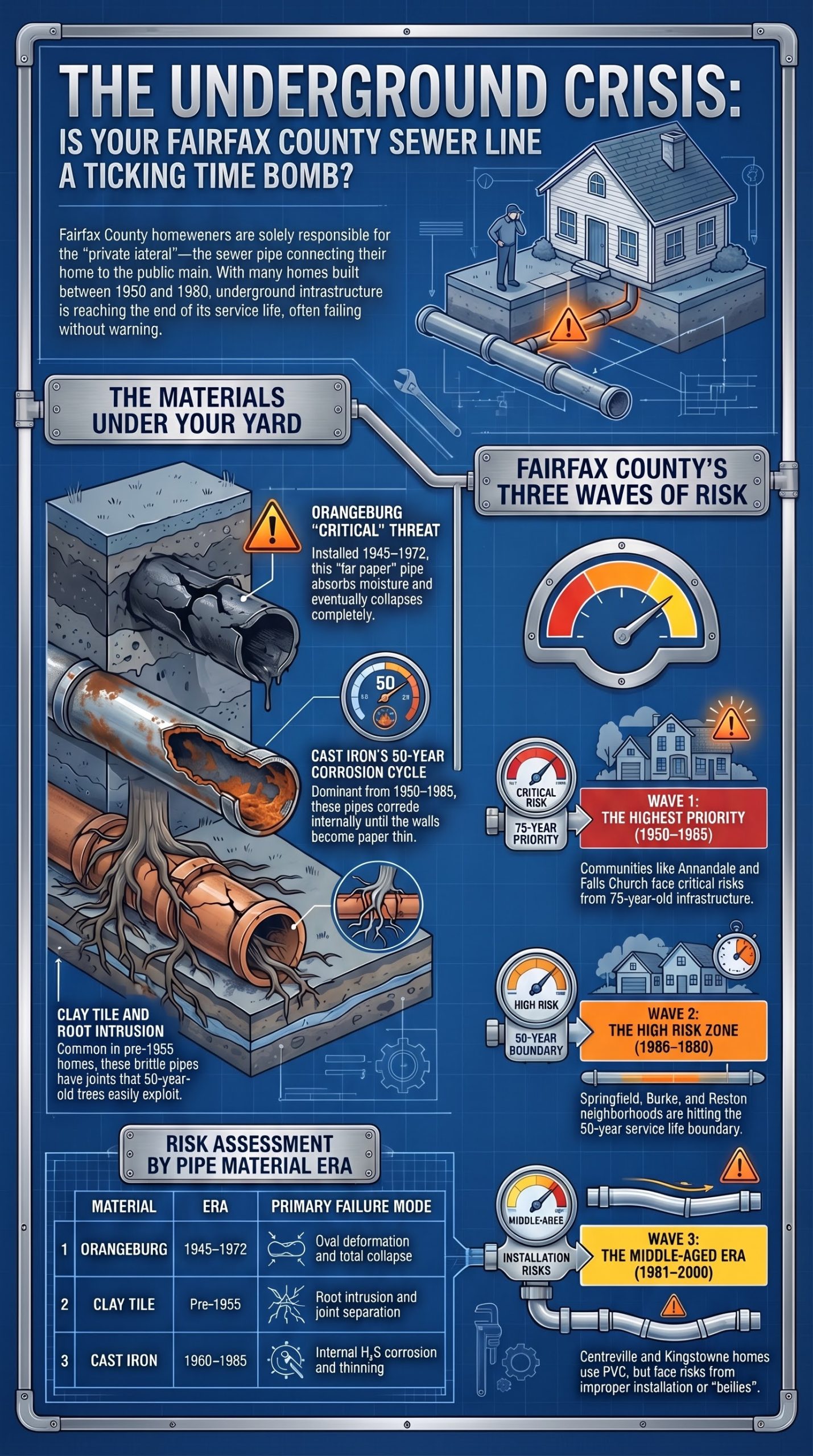
Veteran Plumbing Services has served Fairfax County homeowners for years, and the camera inspections we run tell a story that no surface inspection ever could. The clay tile laterals beneath Falls Church homes from the 1950s. The Orangeburg pipe still in service under mid-century ranches in Annandale and Lincolnia. The cast iron stacks in Springfield split-levels that have been corroding from the inside for six decades. The root-compromised joints in McLean’s wooded neighborhoods where mature oaks have had 40 years to find every weak seam in the pipe below. This article is the complete, honest account of what is happening underground in Fairfax County — community by community, material by material, warning sign by warning sign — and what every homeowner in every corner of this county should understand before the next call becomes an emergency.
Chapter 1 of 8
The Age Crisis — Fairfax County’s Sewer Infrastructure by the Numbers
To understand the scope of Fairfax County’s aging sewer problem, you need to understand when Fairfax County was built. The answer is: in waves, each wave leaving a distinct infrastructure signature that is now aging out at different rates across different communities.
1950s–1965
First suburban wave: Falls Church, Annandale, Lincolnia, Bailey’s Crossroads, parts of McLean. Clay tile and Orangeburg pipe. Now 60–75 years old.
1966–1980
Second wave: Springfield, Burke, Fairfax, Oakton, Vienna environs, Herndon, Reston. Cast iron and early PVC. Now 45–60 years old.
1981–2000
Third wave: Centreville, Chantilly, Sully Station, Kingstowne, South Run, Newington. PVC-dominant, but entering middle age. Now 25–45 years old.
The Fairfax County Water Authority operates and maintains approximately 3,400 miles of water and sewer mains throughout the county. That is the public infrastructure — the mains running under the streets and in the utility easements. What those figures do not include is the private lateral: the section of sewer pipe connecting each individual home to the nearest public main. There is no centralized registry of private lateral age, material, or condition. There is no mandatory inspection program. There is no county-funded replacement initiative. Every lateral in every Fairfax County neighborhood is the sole responsibility of the homeowner who owns the property above it, and the vast majority of those homeowners have never had it inspected.
Estimates from the American Society of Civil Engineers suggest that the United States has more than one million miles of aging sewer infrastructure approaching or past its design life. Fairfax County is not an outlier in this national picture. It is a microcosm of it, with the added variable that its first-wave suburban development concentrated hundreds of thousands of aging laterals in a dense, well-maintained, high-value residential landscape where the financial consequences of failure are steep and the disruption is significant.
Chapter 2 of 8
The Materials — What Is Actually Underground and Why It Is Failing
What failed means depends entirely on what was installed. Fairfax County’s residential sewer laterals span four primary material eras, each with its own failure mode and its own timeline. Understanding which material is in the ground beneath a specific home is the starting point for assessing risk.
Clay Tile Pipe — The Oldest Generation
Clay tile was the dominant residential sewer material from the late 1800s through the mid-1950s. It is a fired ceramic pipe installed in short sections with open joints sealed loosely with oakum or mortar. Clay tile is chemically inert and resistant to internal corrosion, which is why some sections are still functioning after 70 years. Its vulnerabilities are structural and mechanical: the jointed sections separate under soil movement, the joints provide no resistance to root intrusion, and the brittle material cracks under point loads. Homes in Falls Church, parts of McLean, older sections of Annandale, and the earliest-developed areas of Vienna and Fairfax City adjacent communities are the most likely to have original clay tile laterals still in service.
Clay tile and root intrusion: A clay tile lateral in a neighborhood with 50-year-old trees has been defending its joints against active root systems for decades. By now, most uninspected clay tile laterals in Fairfax County’s oldest neighborhoods have root involvement at some portion of the run. The question is not whether roots are present — they almost certainly are. The question is how much of the pipe’s effective diameter they have consumed.
Orangeburg Pipe — The Most Urgent Problem
Orangeburg pipe — made from compressed layers of pitch and cellulose fiber — was produced from the 1860s but became widely used in residential sewer construction from World War II through the early 1970s. It was cheaper than clay and cast iron, easier to work with, and was considered adequate for the residential applications of its era. The material’s fatal flaw was discovered after installation: it absorbs moisture over time and deforms from a round cross-section to an oval, then to a collapsing form. Once deformation begins, it cannot be stopped without replacement. An Orangeburg pipe that was installed in 1962 has been absorbing groundwater for over 60 years. At typical deformation rates, many of these pipes are now significantly compromised — or completely failed.
Orangeburg is the material that produces the most urgent and expensive sewer failures in Fairfax County’s older neighborhoods. Unlike a cracked clay pipe that may still function at reduced capacity for years, an Orangeburg pipe that has collapsed creates a complete blockage without warning. Neighborhoods developed between 1945 and 1970 — including large sections of Annandale, Lincolnia, Bailey’s Crossroads, parts of Springfield, parts of West Springfield, and the older sections of Fairfax — are the highest-probability Orangeburg zones in the county. For more on Orangeburg-specific risks, Veteran Plumbing has published a detailed reference on the dangers of Orangeburg sewer lines in Fairfax County.
Cast Iron Drain Pipe — The Silent Corroder
Cast iron became the dominant residential drain material from the 1950s through the 1980s and remains in service in millions of homes across Northern Virginia. It is significantly more durable than Orangeburg and more structurally sound than clay tile in most soil conditions, but it corrodes from the interior through a specific mechanism: hydrogen sulfide gas produced by organic decomposition in the drain reacts with iron to form iron sulfide, creating a rough, pitted interior surface that catches debris and thins the pipe wall over decades. A cast iron drain stack in a Springfield split-level from 1971 is now 55 years into this corrosion process. The exterior of the pipe may look intact. The interior may be a fraction of its original wall thickness.
Early PVC — Not Immune to Problems
PVC pipe became standard in residential construction through the 1980s and 1990s and represents the newest generation of laterals in Fairfax County’s third-wave communities: Centreville, Chantilly, Sully Station, Kingstowne, South Run, West Springfield, and Newington. PVC does not corrode and does not deform under moisture. It is not, however, immune to problems. Joints installed with improper solvent cement fail over time. Pipe bedding that was inadequate in the original installation allows the pipe to settle and belly. Root intrusion at joints that were not properly sealed occurs in all pipe materials. PVC laterals installed in the 1980s are now approaching 40 years of service — not a crisis age, but the period when installation-era shortcuts begin to manifest as recurring problems.
Lateral Material Summary: What Each Material Means for Your Home
| Material | Install Era | Design Life | Primary Failure Mode | Risk Level in FC |
|---|---|---|---|---|
| Clay Tile | Pre-1955 | 50–80 yrs | Joint separation, root intrusion, cracking | High |
| Orangeburg | 1945–1972 | 30–50 yrs | Moisture deformation, oval collapse | Critical |
| Cast Iron | 1950–1985 | 50–70 yrs | Internal H₂S corrosion, wall thinning | High |
| Early PVC | 1975–2000 | 50–100 yrs | Joint failure, pipe belly, root intrusion | Moderate |
Chapter 3 of 8
The Soil and Climate Variables That Make Northern Virginia Especially Hard on Pipes
The material in the pipe is only part of the failure equation. What surrounds the pipe — the soil in which it is embedded — determines how fast each failure mode progresses and adds failure modes that the pipe material alone never anticipated.
The Piedmont Clay Problem
The majority of Fairfax County sits on clay-dominant Piedmont soils. Clay soil expands when it absorbs moisture and contracts when it dries. This expansion-contraction cycle generates lateral forces on buried pipes that repeat seasonally, year after year, for decades. A clay tile lateral that was perfectly aligned and jointed in 1958 has experienced this lateral stress for nearly 70 years. The cumulative effect is joint displacement, pipe movement, and the gradual opening of gaps that tree roots then exploit. For cast iron, the same soil movement creates bending stress at support points, and a pipe wall already thinned by interior corrosion can crack under the lateral load that a newer pipe would have withstood.
Fairfax County’s Freeze-Thaw Cycle
Northern Virginia experiences approximately 30 to 50 freeze-thaw cycles per year — periods where soil temperature passes through 32°F in both directions. Each transition generates expansion and contraction in the soil that surrounds and supports underground pipes. At typical sewer lateral depth in residential construction, this thermal cycling is attenuated but not eliminated. Over 50 to 60 years, the cumulative effect on pipe joints and bedding material is measurable and contributes to joint offset, pipe settlement, and the gradual development of pipe belly sections where waste pools instead of flowing.
Tree Root Systems in Established Neighborhoods
Fairfax County’s residential neighborhoods are defined in part by their mature tree canopy — the oaks, maples, sycamores, and willows that line residential streets and fill suburban yards across communities from McLean to Merrifield. Those trees are also one of the most persistent threats to aging sewer laterals. Root systems follow moisture, and a leaking clay tile joint or a deteriorated Orangeburg section is a moisture source that roots will locate and exploit. The willows in creek-adjacent neighborhoods near Lake Barcroft, Burke Lake, and Accotink Creek are particularly aggressive — willow root systems can extend 30 to 50 feet from the tree base and seek out any available moisture source with remarkable persistence.
The root intrusion sequence: Roots do not break into a healthy pipe. They find gaps at deteriorated joints and grow inward. Once inside, they fill the available space, creating a mesh that catches debris. Flow slows, backup risk increases, and the root mass continues to grow. By the time a homeowner experiences a backup from root intrusion, the root system inside the pipe has typically been present for months or years. A camera inspection before any backup occurs is the only way to catch root intrusion at a stage where clearing alone, rather than pipe replacement, may be sufficient.
The Depth Variable
Sewer laterals in Fairfax County’s older residential construction were installed at variable depths depending on the grade of the lot, the depth of the public main connection, and the construction practices of each individual builder. Shallower installations, particularly those in the 24 to 36-inch depth range, experience more severe freeze-thaw cycling and are more vulnerable to surface traffic loads on driveways and vehicle turnaround areas. Many homeowners who have had driveways repaved or who regularly drive heavy vehicles over the portion of their yard above the lateral are unknowingly applying dynamic loads to a pipe that was never designed for vehicular traffic.
Chapter 4 of 8
Community by Community — Where the Problem Is Most Urgent in Fairfax County
Fairfax County is not a monolith. Its 400-square-mile footprint contains communities developed across seven decades, with very different infrastructure profiles. The following community overview organizes Fairfax County’s towns, incorporated communities, and unincorporated neighborhoods by their sewer infrastructure risk, based on development era and dominant pipe material.
Highest Priority: Pre-1965 Communities
These communities contain the highest concentration of clay tile and Orangeburg pipe laterals that are now 60 to 75 years old. Any home built before 1965 in these areas should be treated as a priority for camera inspection if none has been performed.
Falls Church (areas adjacent to the independent city): The residential neighborhoods in the portions of Fairfax County that border Falls Church — West Falls Church, Pimmit Hills, and Idylwood — were developed heavily in the 1950s and contain some of the county’s oldest residential sewer infrastructure. Veteran Plumbing has documented what camera inspections reveal in Falls Church homes built before 1985, and the findings in the pre-1965 section of that community are among the most consistently compromised anywhere in the county.
Annandale: One of Fairfax County’s oldest and most densely developed unincorporated communities, Annandale was built out heavily in the 1950s and 1960s. The older sections, particularly those north of Braddock Road and along Columbia Pike, contain a mix of clay tile and Orangeburg pipe that is now at or past the outer boundary of its expected service life. The community’s established tree canopy adds significant root pressure to joints that have been under stress for decades.
Lincolnia, Bailey’s Crossroads, and Seven Corners: These communities along the Route 7 and Route 50 corridors represent some of the densest postwar residential development in the county. Many of the single-family homes and garden-style townhouses in these areas were built in the late 1950s and early 1960s on original Orangeburg or clay tile sewer connections that have had no inspection or service since installation.
Dunn Loring and Idylwood: The neighborhoods in the Dunn Loring and Idylwood areas developed primarily in the 1950s, and their proximity to Tysons Corner’s transit-oriented development has brought significant renovation activity. Renovated homes with updated bathrooms and kitchens put higher water volume demand on laterals that were sized and installed for mid-century household use patterns. Increased flow through a deteriorated pipe accelerates failure.
McLean: McLean’s older sections, particularly those along Balls Hill Road, Old Chain Bridge Road, and the residential streets between Route 123 and the Potomac River, contain mid-century homes on large wooded lots with some of the most severe root-intrusion risk in the county. Veteran Plumbing has published an in-depth look at what the ground under McLean yards is hiding in terms of broken sewer laterals.
Merrifield and Mosaic District surroundings: Merrifield’s older residential stock, which predates the area’s recent transit-oriented development boom, sits on some of the oldest sewer infrastructure in eastern Fairfax County. The disconnect between renovated-facade properties and original underground infrastructure here is particularly sharp. For a detailed account of root intrusion in this community, see how tree roots quietly destroy Merrifield sewer lines from the inside out.
High Priority: 1965–1980 Communities
These communities represent the heart of Fairfax County’s second suburban wave, developed primarily with cast iron drain systems and the transition from Orangeburg to early PVC for sewer laterals. Homes from this era are between 45 and 60 years old — at or approaching the service life boundary for cast iron.
Springfield and North Springfield: Springfield developed intensively from the mid-1960s through the late 1970s across a range of housing types from garden apartments to split-level single-family homes. The cast iron drain systems in these homes are now 45 to 60 years into their service life, and the flat terrain of many Springfield neighborhoods creates the low-slope drain line conditions that accelerate interior accumulation. Veteran Plumbing has published on Springfield sewer backups and on the persistent clogged drain battle in Springfield neighborhoods. The Rolling Valley, Saratoga, and Newington Forest sections are among the most active service areas for drain and sewer problems in the county.
Burke and Burke Centre: Burke’s development peak of the 1970s and early 1980s produced large quantities of homes on clay-heavy soils with sewer laterals now in the 40 to 55-year range. The combination of Orangeburg pipe in the earliest Burke sections, cast iron in the middle period, and early PVC in Burke Centre’s later phases creates a varied infrastructure picture that a camera inspection is the only reliable way to assess. For community-specific context, see why Burke homeowners keep calling about sewer lines.
Fairfax (Fairfax City-adjacent communities): The unincorporated communities around the City of Fairfax, including the neighborhoods along Old Lee Highway, Main Street corridors, and the residential streets feeding into Route 50 and Route 29, developed across the 1960s and 1970s. Homes in these areas that have been owner-occupied for decades and have never had a plumbing inspection carry the highest deferred maintenance risk of any property type in Fairfax County. Veteran Plumbing covers drain warning signs for this community in depth: that bubbling sound in Fairfax drains is trying to warn you.
Reston: Reston’s planned community development from 1964 onward produced one of the most geographically concentrated residential infrastructure aging problems in Northern Virginia. The combination of original 1960s construction in North Point, Hunters Woods, Lake Anne, Laurel Glade, and South Lakes with the community’s stated commitment to its natural environment — which means mature tree canopy throughout — creates persistent root intrusion risk on aging lateral infrastructure throughout the community.
Herndon and Herndon adjacent communities: The Town of Herndon and its surrounding unincorporated areas, including the neighborhoods along Elden Street, Van Buren Street, and the residential sections near the Dulles Toll Road corridor, carry homes from the 1970s and early 1980s with sewer infrastructure that is approaching the 50-year mark. The water pressure issues documented in Herndon’s aging supply lines often share root causes with the drain and sewer infrastructure of the same era.
Vienna (Town of Vienna) and surrounding communities: The Town of Vienna has its own municipal utility infrastructure for properties within the town limits, but the surrounding unincorporated areas of Fairfax County — including Tysons-adjacent neighborhoods and the residential streets east and west of the Route 123 corridor — contain homes from the 1960s and 1970s with sewer infrastructure that mirrors the risk profile of other second-wave Fairfax County communities.
Oakton: Oakton’s mix of mid-1970s and early 1980s single-family residential development, combined with its position in some of the county’s most wooded terrain east of the Bull Run Mountains, creates an active root intrusion environment for clay and cast iron laterals. For emergency response guidance specific to this community, see what Oakton families do first in a Fairfax County drain emergency.
Franconia and Rose Hill: The communities along the Franconia Road and Rose Hill Drive corridors developed through the late 1960s and 1970s with moderate-density residential construction that is now at the 45 to 55-year mark on original infrastructure. The proximity to I-95 and the dynamic soil environment created by heavy regional traffic loads on nearby roadways adds stress to laterals in this community.
Pimmit Hills, Wolf Trap, and Langley: These communities in the western McLean area, including Pimmit Hills and the residential sections adjacent to the Wolf Trap National Park for the Performing Arts, developed in the 1950s through early 1970s with varied pipe materials that reflect their multi-decade build-out. Homes in the oldest sections of Pimmit Hills carry some of the county’s most at-risk original infrastructure.
Moderate Priority: 1981–2000 Communities
Communities developed in the 1980s and 1990s are now in the 25 to 45-year range — not in crisis, but at the age where installation-era shortcuts begin to surface, root systems that were planted with the homes are now mature, and pipe belly sections from inadequate original bedding are producing recurring slow drain complaints.
Centreville: Centreville’s development across the 1980s and 1990s, with large residential communities including Centreville Crossing, Sully Station, and the Route 29 corridor developments, places much of its sewer infrastructure in the moderate-priority range. The sump pump challenges documented for Centreville homeowners share the same clay soil and drainage context that affects lateral condition throughout the community. Early inspections in Centreville’s 1980s-era sections are worth scheduling proactively.
Chantilly and Sully Station: These communities along the Route 28 and Route 50 corridors developed primarily in the late 1980s and early 1990s. Original PVC laterals in these communities are now 35 to 40 years old — approaching the window where installation-quality differences begin to manifest as problems.
Kingstowne and South Run: Kingstowne, developed from the mid-1980s through the late 1990s, and the South Run community represent some of Fairfax County’s more recent large-scale residential developments. The PVC laterals here are in the 25 to 40-year range, with lower immediate risk than older communities but warranting attention in homes where the oldest sections of the community’s development were completed in the mid-1980s.
Newington, Newington Forest, and Fort Belvoir environs: The residential communities in the southern Fairfax County corridor near Fort Belvoir, including Newington and Newington Forest, developed in the 1980s and carry PVC infrastructure that is now entering middle age. The proximity to active military facility infrastructure and the dynamic soil conditions from the Route 1 corridor create a somewhat more demanding environment for residential laterals in this area.
Fairfax Station: Fairfax Station’s residential development, concentrated in the 1980s and spanning a mix of rural-adjacent and suburban properties, presents an interesting dual profile: newer construction standards but mature tree growth on properties with significant lot sizes. Veteran Plumbing has addressed the specific multi-fixture backup dynamic at Fairfax Station homes.
Clifton (Town of Clifton): Clifton stands apart from every other Fairfax County community in its infrastructure profile. As the county’s most historically preserved town, with a character and building stock that predates most of Fairfax County’s suburban development, Clifton contains some of the county’s oldest residential plumbing infrastructure alongside its more recent residential additions. The four-stage collapse progression for Clifton sewer lines is documented in detail at the 4 stages of a collapsing sewer line in Clifton.
Bon Air, Groveton, Hybla Valley, and Mount Vernon: The communities along the Route 1 corridor in southern Fairfax County — including Bon Air, Groveton, Hybla Valley, and the Mount Vernon area — developed across several decades beginning in the 1950s and continuing through the 1970s. The older sections of these communities carry infrastructure risk comparable to Annandale and Springfield, while more recent development phases present the moderate-priority profile of 1980s-era construction.
Lake Barcroft and Belle Haven: Lake Barcroft’s residential community, centered on the lake amenity in Falls Church-adjacent Fairfax County, and Belle Haven along the Mount Vernon corridor contain homes from the 1950s through the 1970s in established, wooded neighborhoods where root intrusion and aging joint integrity are the primary concerns. The proximity to water features in both communities elevates groundwater table levels and increases soil moisture around lateral joints.
Kings Park West, West Springfield, and West Fairfax: These communities in the Springfield-Burke transition zone developed heavily in the mid-1970s and early 1980s. Cast iron and early PVC laterals from this era are entering the period where interior cast iron corrosion produces the recurring slow drain pattern that camera inspection most clearly explains.
Chapter 5 of 8
The Warning Signs — What Fairfax County Homeowners Are Ignoring Right Now
The most consistent finding in post-failure sewer calls throughout Fairfax County is this: the warning signs were present for weeks or months before the backup occurred. They were noticed. They were attributed to something else. And they were not acted on until the problem forced the issue. The following signs are not ambiguous when they appear together. Each one, in a home with aging infrastructure, warrants a call for a camera inspection.
The Seven Warning Signs of a Failing Sewer Lateral
- Slow drains in multiple fixtures simultaneously — a single slow drain is often a fixture-level clog. Multiple slow drains on the same day, across different rooms, point at the main lateral downstream of all of them.
- Gurgling sounds from the toilet when another fixture drains — the toilet is drawing air through its trap because the vent system or the main line is under pressure or blockage. See what that gurgling sound means for Fairfax homeowners.
- Sewage odor in the basement, crawl space, or near floor drains — sewer gas entering the living space means a trap has dried, a vent is blocked, or a lateral has a crack or offset joint that is releasing gas before it reaches the main.
- Recurring backups that clear on their own — a partial root blockage clears temporarily when water volume drops. The backup was real. The problem did not resolve.
- Wet or soft spots in the yard, particularly above the lateral route — sewage escaping a cracked or offset joint saturates the soil above it. What looks like poor drainage may be active sewage exfiltration.
- Unusually vigorous or green grass in a strip across the yard — nutrient loading from escaping sewage creates a distinct growth pattern directly above a compromised lateral.
- Unexplained pest activity near the basement or foundation — rats and roaches follow sewer gas and moisture. A sudden appearance of either in a home with no other explanation is a sewer integrity flag that plumbers take seriously.
Any two of these signs present simultaneously in a home with infrastructure from the 1950s through 1970s is a prompt to call for a camera inspection before anything else. Any single one of these signs in an older home that has never had a camera inspection is worth taking seriously. The cost of a camera inspection is a fraction of the cost of an emergency backup event, a slab repair, or a full lateral replacement done under emergency conditions.
Chapter 6 of 8
Inside the Camera — What a Sewer Inspection Actually Reveals
A sewer camera inspection is the only tool that converts the risk assessment described in the previous chapters into a specific, actionable, documented picture of an individual home’s actual lateral condition. No surface inspection, no symptom review, and no professional estimate of age-based probability replaces the footage that a camera run produces. What follows is a description of what those inspections consistently reveal in Fairfax County homes across the different material and era profiles described above.
What the Camera Actually Shows
A push-rod camera is introduced at the cleanout access point — typically in the basement or in the yard — and advanced through the lateral toward the main connection. The operator receives live video of the pipe interior at every foot of the run, with a distance counter and, in most modern systems, a locator signal that allows the camera head to be pinpointed at the surface above it. Findings are recorded and time-stamped, and a condition report is produced that documents each defect type, its location, and its severity.
The five most common camera findings in Fairfax County homes: Root intrusion at joint locations (most common in clay tile and early PVC), pipe belly sections where the grade has reversed and waste pools (most common where soil has settled under improperly bedded sections), Orangeburg deformation ranging from early oval shape to near-collapse, offset joints where sections have shifted out of alignment, and active cracks in cast iron or clay pipe wall that are allowing soil intrusion or sewage exfiltration. In most Fairfax County homes from the pre-1980 era where we run a camera for the first time, we find at least one of these conditions. In many homes we find two or three.
What the Camera Does Not Do
A camera inspection documents existing conditions at the time of inspection. It does not predict the exact timeline to failure for a deteriorated pipe — only the condition at the time of the run. A lateral that shows moderate root intrusion and early Orangeburg deformation in today’s inspection may function adequately for another two years or may fail within six months, depending on rainfall patterns, household water use volume, and whether root growth accelerates at the observed intrusion points. The camera gives you the information to make a decision. It does not make the decision for you, and a plumber who tells you a borderline condition is definitely fine for another decade or definitely failing immediately should be asked how they know that, because the camera footage does not contain that certainty.
Reading the Findings: A Scale That Matters
NASSCO (the National Association of Sewer Service Companies) has developed a standardized Pipeline Assessment and Certification Program (PACP) that assigns structural defect grades from 1 to 5, where 1 represents minor defects and 5 represents immediate structural failure. When Veteran Plumbing Services provides you with camera footage and a condition report, we are using this same graduated assessment framework. A grade 3 finding — significant root intrusion, noticeable Orangeburg deformation, or a moderate pipe offset — is a finding that warrants a repair plan and timeline, not immediate panic, but absolutely not dismissal. A grade 4 or 5 finding is a finding that warrants repair before the next significant household water use event.
Chapter 7 of 8
Your Repair Options — From Targeted Lining to Full Lateral Replacement
Once a camera inspection has documented what is actually in the ground, the repair decision becomes much more straightforward than most homeowners expect. The condition of the pipe, combined with the specific defects found, determines which repair approach is both technically appropriate and cost-effective for the situation. The following overview covers the full spectrum of options available to Fairfax County homeowners.
Hydro-Jetting — Not a Repair, But a Temporary Relief
Hydro-jetting introduces high-pressure water into the lateral at up to 4,000 PSI to cut through root masses, break up grease accumulation, and clear debris from the pipe interior. It is highly effective at clearing blockages that snaking does not fully address and can restore flow in a pipe that has significant but not complete blockage. What hydro-jetting does not do is repair the pipe or prevent future root intrusion. A lateral that is hydro-jetted without addressing the open joint that allowed roots in will be re-colonized. Hydro-jetting buys time. It is not a solution for a structurally compromised lateral.
Cured-in-Place Pipe Lining (CIPP) — The Trenchless Solution
CIPP lining is the trenchless rehabilitation method most appropriate for Fairfax County’s mix of older pipe materials and established landscaping. A flexible liner saturated with epoxy resin is inserted into the existing lateral through an access point, inflated to press against the existing pipe wall, and cured with heat or UV light to create a structurally independent new pipe inside the old one. The result is a continuous, joint-free pipe liner with a smooth interior surface and a design life of 50 or more years. CIPP is appropriate for root intrusion, moderate deformation, cracking, and joint offsets in pipe that retains enough structural integrity to support the liner during installation.
When CIPP is the right choice for a Fairfax County home:
- Root intrusion at multiple joint locations throughout the lateral run
- Early to moderate Orangeburg deformation where the pipe retains approximately circular shape
- Clay tile with significant joint separation but intact pipe sections between joints
- Cast iron with internal corrosion but wall thickness still sufficient to support the liner
- Historic district or established landscape properties where open-cut excavation would damage mature trees, hardscaping, or heritage landscaping
Pipe Bursting — The Trenchless Replacement Method
Where CIPP rehabilitates the existing pipe, pipe bursting replaces it entirely — without open-cut excavation. A bursting head is pulled through the existing lateral by a cable, fracturing the old pipe outward as it advances and simultaneously pulling a new HDPE (high-density polyethylene) pipe into the space the old pipe occupied. Pipe bursting is appropriate when the existing pipe’s condition is too deteriorated for lining — collapsed Orangeburg, severely offset cast iron, or extensively deteriorated clay tile — but the general route of the existing lateral is correct and open-cut excavation would be disproportionately disruptive.
Open-Cut Excavation and Replacement
Open-cut replacement remains the appropriate choice when the lateral route must change, when the pipe has collapsed in a way that neither lining nor bursting can traverse, when the depth or soil conditions make trenchless methods impractical, or when multiple components including the connection to the public main require access. In Fairfax County communities where the lateral runs beneath a concrete driveway, a significant hardscape feature, or a structure, the cost-benefit of open-cut versus trenchless methods becomes a project-specific calculation. In yards with established landscaping, trenchless methods generally preserve significantly more value than the cost differential between methods would suggest.
Spot Repair
When a camera inspection identifies a single, isolated defect — one offset joint, one crack at a specific location, one root entry point — a targeted spot repair that excavates only at the defect location and replaces or reinforces that section is both technically appropriate and cost-effective. Spot repair is not appropriate when multiple defects exist at different points in the run, because addressing one location leaves the others to progress and produces a return visit on the customer’s timeline or a failure on the pipe’s timeline.
Chapter 8 of 8
The Action Plan — What Every Fairfax County Homeowner Should Do Before the Next Backup
The entire framework of this article — the material profiles, the community-by-community risk assessment, the warning signs, the camera findings, and the repair options — points to a single, concrete action for every Fairfax County homeowner reading it. That action is not expensive. It is not disruptive. And it is the only thing that converts general risk awareness into specific, actionable knowledge about your home.
Your Sewer Lateral Action Plan by Home Age
Built before 1970 and never had a camera inspection: Schedule one now, before symptoms appear. The inspection documents what is there. If the finding is good, you have documented proof of your lateral’s condition for the record and your own peace of mind. If the finding reveals problems, you address them on your schedule and your budget, not in response to a sewage backup at midnight on a holiday weekend.
Built between 1970 and 1985, no inspection in the past 5 years: Schedule a camera inspection within the next maintenance cycle. Cast iron drain lines in these homes are approaching or at the end of their designed service life. The inspection’s findings determine whether the timeline is urgent or moderate.
Built between 1985 and 2000, currently experiencing any of the warning signs: Do not attribute the gurgling, the slow drains, or the odor to normal aging and defer. The warning signs in Chapter 5 are worth acting on promptly in any home, regardless of age. Schedule a camera inspection as the first diagnostic step before any other drain service.
Any age, currently experiencing active backup: Stop using water from that system. Call Veteran Plumbing Services immediately at 703.791.1339. An active backup in a home on a municipal sewer system is a plumbing emergency. The cause needs to be diagnosed before the system is used further.
What the Inspection Does for Your Property Value
In Fairfax County’s real estate market, a documented sewer lateral inspection with a clean or recently-repaired condition report is an increasingly valuable disclosure asset. Buyers and their inspectors are asking about lateral condition in older homes, and sellers who can produce camera footage and a condition report are in a measurably better negotiating position than those who cannot. An inspection performed proactively and at your convenience costs less than an inspection negotiated as a contingency after an offer is accepted — and dramatically less than a lateral repair negotiated as a closing credit from the buyer’s position of maximum leverage.
The Fairfax County Water Authority Perspective
The Fairfax County Water Authority is responsible for the mains in the street and in utility easements. Their jurisdiction ends at the connection point. The lateral from your home to that connection is your responsibility under Virginia law and under the FCWA’s service agreement terms. The FCWA does not inspect private laterals, does not repair them, and in the event of a sewage backup into your home from a private lateral failure, the FCWA’s responsibility begins and ends at the main. This is not a criticism of the FCWA — it is the standard legal and operational boundary for virtually every municipal sewer utility in the country. It is simply the reality that every Fairfax County homeowner on public sewer needs to understand before they have a problem.
Veteran Plumbing Services — Fairfax County’s Trusted Sewer Experts
Ready to Know What Is Under Your Yard?
Veteran Plumbing Services provides camera inspections, sewer line repair, trenchless pipe lining, and full lateral replacement throughout every community in Fairfax County — from Annandale to Centreville, Clifton to Reston, McLean to Springfield. Veteran-owned. Honest pricing. Work done right the first time.
Summary
Fairfax County’s residential sewer infrastructure spans seven decades of development and four distinct pipe material eras. The oldest communities — Annandale, Falls Church-adjacent neighborhoods, parts of McLean, Lincolnia, Bailey’s Crossroads, and the earliest sections of Springfield and Fairfax — contain clay tile and Orangeburg pipe that is now 60 to 75 years old and at or past the outer boundary of its expected service life. The second-wave communities — Burke, Reston, Herndon, Vienna-adjacent areas, Oakton, Merrifield, Fairfax Station, and most of Springfield and North Springfield — carry cast iron and early PVC infrastructure from the 1966 to 1980 period that is entering the high-risk zone at 45 to 60 years of service. The third-wave communities — Centreville, Chantilly, Kingstowne, South Run, Newington, and Sully Station — carry 1980s and 1990s-era PVC that is moderate-risk but not without concerns at 25 to 40 years of service.
Northern Virginia’s clay-dominant Piedmont soils, freeze-thaw cycling, and mature tree root systems accelerate the failure of every pipe material type by adding external mechanical stress to pipes that are already degrading from within. The private sewer lateral — the pipe from your foundation to the public main in the street — is entirely the homeowner’s responsibility under Fairfax County Water Authority service terms and Virginia law.
The warning signs of a failing lateral are observable before the backup occurs. A camera inspection is the only tool that converts general age-based risk into specific, documented knowledge about an individual home’s lateral condition. The repair options available — from hydro-jetting to trenchless lining to full lateral replacement — span a wide range of costs and invasiveness, and the appropriate choice is determined by what the camera actually shows. The action for every Fairfax County homeowner with a home built before 1985 and no camera inspection on record is the same: schedule one. The cost of proactive knowledge is a fraction of the cost of reactive emergency response.
References
Fairfax County Water Authority. (2024). Annual comprehensive financial report and infrastructure asset data for Fairfax County water and sewer systems. FCWA. https://www.fairfaxwater.org
American Society of Civil Engineers. (2021). 2021 infrastructure report card: Wastewater. Aging sewer infrastructure in American municipalities. ASCE. https://www.infrastructurereportcard.org/cat/wastewater
National Association of Sewer Service Companies. (2022). Pipeline Assessment and Certification Program (PACP): Defect grading standards for residential and municipal sewer lateral inspection. NASSCO.
U.S. Environmental Protection Agency. (2021). Aging water infrastructure: Private lateral sewer condition, failure rates, and rehabilitation guidance for homeowners. EPA Office of Water. https://www.epa.gov/water-research
Water Research Foundation. (2020). Root intrusion in residential sewer laterals: Entry mechanisms, growth progression, and trenchless remediation options. WRF Technical Report TR-18-13.
Fairfax County Department of Planning and Development. (2022). Housing age and residential development timeline data for Fairfax County unincorporated communities. Fairfax County Government. https://www.fairfaxcounty.gov/planning-development
Virginia Department of Transportation. (2023). Northern Virginia soil classification and Piedmont geology: Implications for underground infrastructure performance. VDOT Research Library. https://www.virginiadot.org/vtrc